
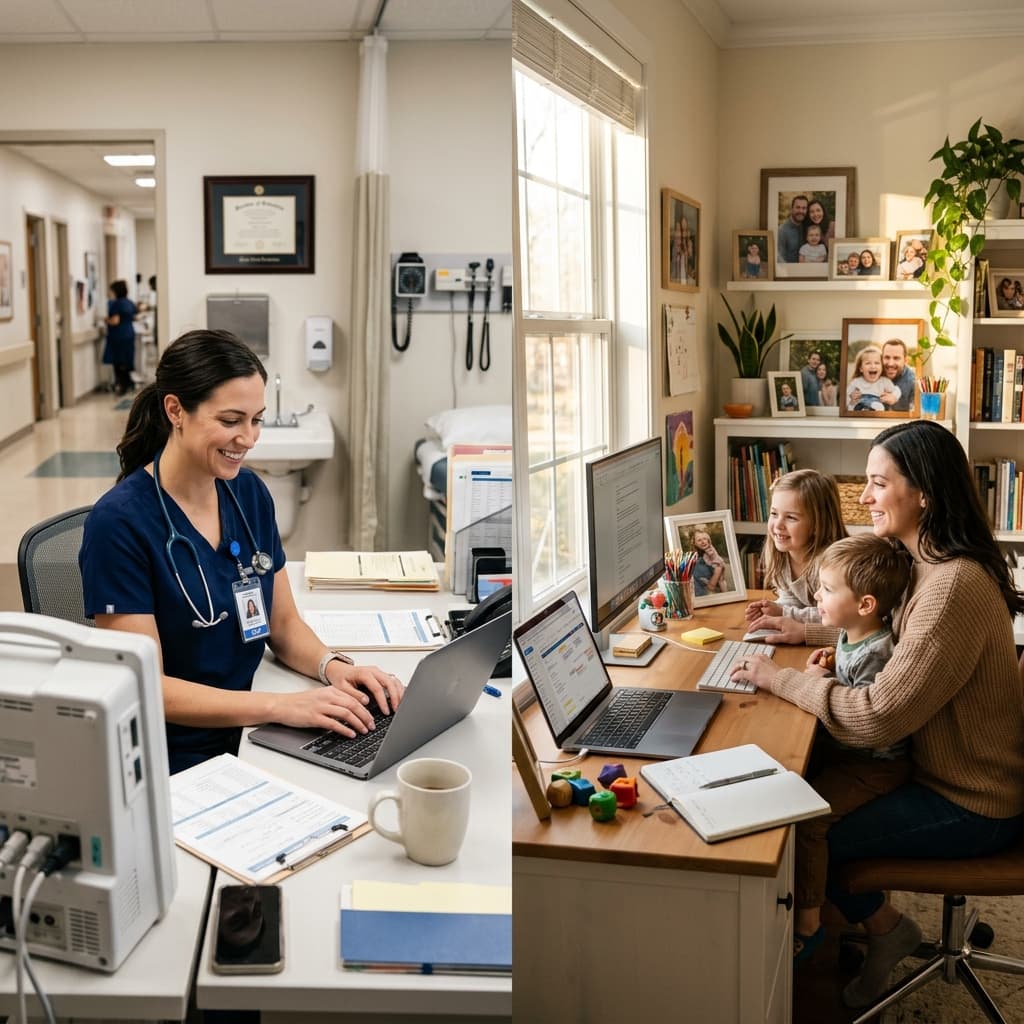
Working as a part-time PMHNP can pay real money—but it depends on how you structure your hours, what setting you choose, and how you’re paid. Two clinicians can both work “part-time” and end up with wildly different take-home pay.
If you want income that feels meaningful (not just “side hustle” money), you’ll need to approach part-time work like a strategy, not a schedule.
Part-time PMHNP pay: what “real money” usually means
Most people asking this question are trying to figure out whether part-time PMHNP work can cover major bills: a mortgage, childcare, student loans, or replacing a full-time income while avoiding burnout.
At a national level, PMHNP compensation commonly lands around $139K–$155K for full-time roles, with entry-level pay often closer to ~$126K. Part-time doesn’t automatically mean half of that. In some models (especially productivity-based or per-visit), a well-built part-time schedule can be surprisingly close to full-time earnings—while a poorly designed one can fall short fast.
The key is how “part-time” is defined. Some employers mean 0.6–0.8 FTE with benefits and a stable base. Others mean true hourly coverage, per diem shifts, or a contractor arrangement where your pay is tied to patient volume.
If you’re trying to benchmark what’s realistic in your area, start by scanning roles in your state (for example, the current mix of listings in California can look very different from other regions). You can browse openings on the PMHNP Hiring state page for https://pmhnphiring.com/jobs/state/california to get a feel for common pay models and expectations.
The pay models that make (or break) part-time income
Part-time income hinges less on your license and more on the compensation structure. Salary-based part-time roles are the simplest: you work a set FTE, you get a predictable paycheck, and your downside is usually a lower ceiling.
Hourly and per diem models can work well when the hourly rate is strong and the schedule is consistent. The catch is that “part-time” often gets paired with evening/weekend coverage, and hours can be cut if census drops.
The biggest swing factor is productivity-based pay (per-visit, RVU, collections, or a hybrid). This is where part-time can turn into real money—if you have enough demand, you’re credentialed quickly, and the clinic’s operations don’t slow you down. It’s also where part-time can become frustrating if no-shows are high, admin time is unpaid, or you’re expected to do a full-time amount of messaging and prior auth work off the clock.
One more nuance: telehealth often pays more than in-person, but pay varies widely by company and state coverage. If you’re considering virtual work, compare listings side-by-side on https://pmhnphiring.com/jobs/telehealth and note whether the role is W2 vs 1099, whether admin time is paid, and how no-shows are handled.
Where part-time PMHNPs earn the most: settings and schedules
In general, part-time PMHNP work pays best when the employer has steady patient demand and clean operations. Telepsychiatry and outpatient medication management tend to be the most “scalable” for part-time because you can stack visits into predictable blocks.
Hospital roles can be steadier but may pay less on average than private practice settings. As a rough benchmark, private practice averages around ~$147K versus hospital around ~$135K (full-time equivalents). That difference doesn’t always translate cleanly to part-time, but it’s a useful directional signal: outpatient settings often have more flexibility to build high-yield blocks.
Schedule design matters as much as setting. Two half-days scattered across the week can create a lot of unpaid “in-between” time—charting, refills, patient portal messages—without enough visit volume to justify it. On the other hand, two full clinic days (or three shorter but tightly packed blocks) often produce better income per hour because your admin time is concentrated.
If you’re open to shift-style coverage, per diem can be a strong option for part-time earners, especially when facilities need reliable weekend or evening help. You can see what’s available on https://pmhnphiring.com/jobs/per-diem and compare how employers define coverage expectations.
What to watch for: hidden time, credentialing delays, and benefits math
Part-time roles can look great on paper and still disappoint in real life. The biggest income killer is hidden time. If your compensation is visit-based but you’re spending hours on inbox work, prior authorizations, and care coordination, your effective hourly rate drops quickly.
Credentialing and onboarding delays are another issue—especially in telehealth or multi-state models. A part-time PMHNP might only have limited weekly availability, so any delay hurts more. Ask upfront about time-to-fill and onboarding timelines; across the market, time-to-fill averages around 32 days, and credentialing can push beyond that.
Then there’s benefits math. A 0.8 FTE role with benefits can be worth more than a slightly higher 1099 rate once you account for health insurance, retirement match, paid time off, and self-employment tax. If you’re comparing offers, it helps to anchor your expectations with current compensation ranges and trends. The PMHNP Hiring https://pmhnphiring.com/salary-guide is a good starting point for national averages, entry-level benchmarks, and how factors like degree level can shift pay.
How to make part-time PMHNP work pay: a practical approach
If your goal is “real money,” start by defining a target monthly take-home number and then work backward. Decide how many patient-facing hours you can realistically sustain, and protect those hours from being eaten by admin.
Next, choose a model that matches your risk tolerance. If you need stability, a part-time employed role with a set FTE is usually the cleanest path. If you can tolerate variability and want upside, a productivity-based outpatient role can pay well—just make sure the clinic has enough demand and operational support.
Finally, shop the market like an operator. Compare multiple listings, not just one. Look at state differences, remote-eligible options (about 62% of roles are remote-eligible), and employer types. If you’re not sure where to start, browsing https://pmhnphiring.com/jobs/remote alongside local roles can quickly show whether part-time flexibility is being priced at a premium or discounted in your target area.
Part-time can be a strong income plan for PMHNPs. But the “real money” version usually comes from tight scheduling, clear boundaries on unpaid work, and choosing a pay model that doesn’t punish you for being part-time.
Browse PMHNP jobs | https://pmhnphiring.com/jobs
Sources Data in this article is sourced from:
- Bureau of Labor Statistics (BLS), Occupational Outlook Handbook, May 2024 — bls.gov/ooh
- American Association of Nurse Practitioners (AANP), NP Fact Sheet, 2025 — aanp.org
- PMHNP Hiring aggregated job board data (May 2026)