
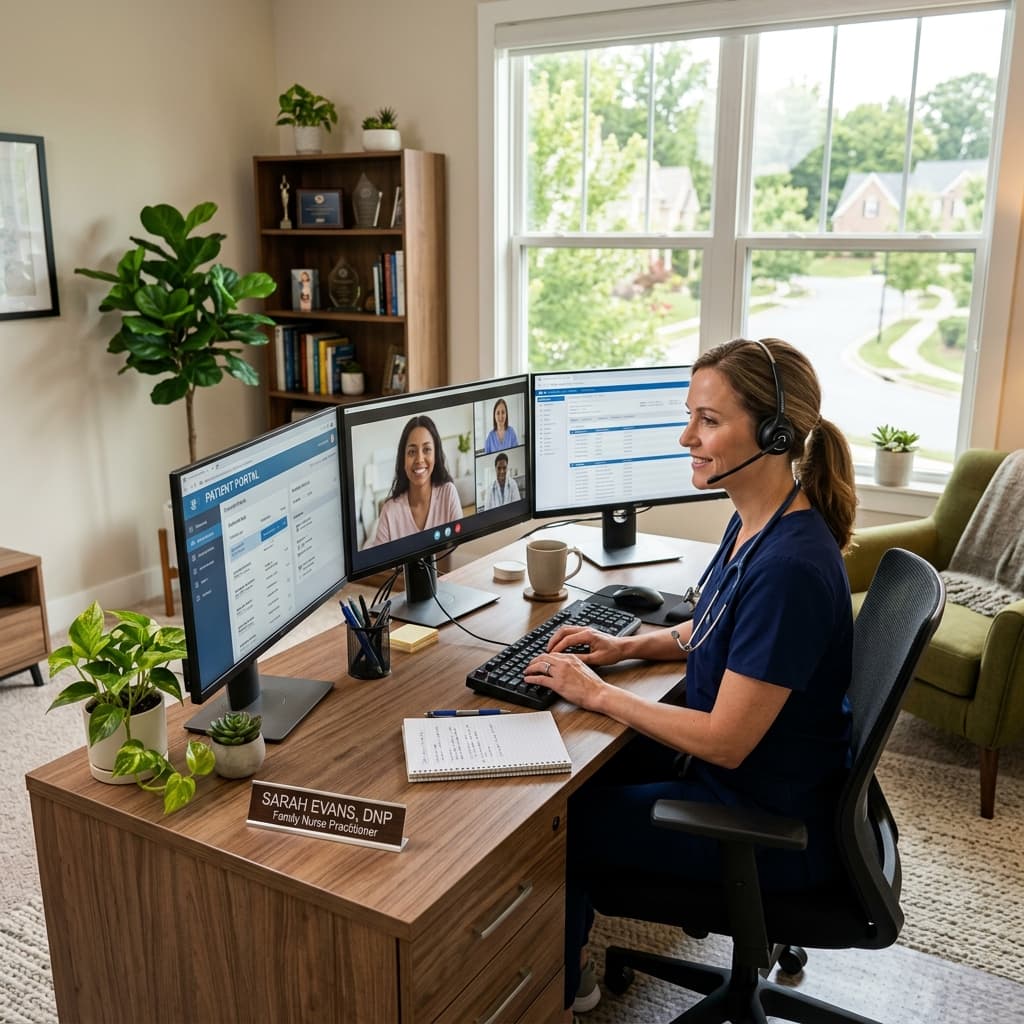
In 2026, 35% of all PMHNP job postings include some form of remote work. Remote PMHNP salaries average $145,000-$180,000 for W-2 positions and $80-$150/hour for 1099 contracts. Success requires multi-state licensure, HIPAA-compliant tech setup, and the ability to build therapeutic rapport through a screen. The remote market rewards PMHNPs who hold 5+ state licenses and have experience with at least one major telehealth platform.
Telehealth has transformed from a pandemic stopgap into a permanent feature of psychiatric care. For PMHNPs, this shift offers unprecedented flexibility — but remote work is a specific clinical skill set, not just a change of location. This guide covers the reality of being a remote psychiatric NP in 2026: what the jobs actually look like, how to position yourself competitively, and what the numbers really say.
The Remote PMHNP Landscape in 2026
Market Data
- 35% of all PMHNP job postings on PMHNP Hiring include a remote or hybrid component — up from 25% in 2024
- Remote-first telehealth companies (Cerebral, Talkiatry, Lifestance, Done, SonderMind) now employ thousands of psychiatric NPs nationwide
- W-2 remote salaries range from $140,000-$180,000 depending on experience and state licensure portfolio
- 1099 contract rates range from $75-$150/hour, with higher rates for intakes and psychiatric evaluations
- Patient demand for telepsychiatry continues growing — 45% of psychiatry patients now prefer video visits over in-person
Types of Remote PMHNP Positions
Not all remote jobs are the same. Understanding the distinctions helps you target the right roles:
| Type | Description | Salary Range | Flexibility |
|---|---|---|---|
| Telehealth-only (patient care) | Full-time video appointments with patients | $140K-$180K (W-2) | Medium — set schedule blocks |
| Hybrid (remote + clinic days) | 2-3 days remote, 1-2 days in clinic | $145K-$185K | Medium-high |
| 1099 contract (supplemental) | Pick your own hours, per-appointment pay | $75-$150/hr | Maximum |
| Utilization review / chart review | Non-clinical, reviewing claims and charts | $110K-$140K | High — often asynchronous |
| Clinical leadership (remote) | Medical director, clinical supervisor roles | $170K-$220K | Varies |
Pros and Cons of Remote PMHNP Work
Advantages
Time savings: The average commute in the US is 27 minutes each way — that's 4.5 hours/week and 234 hours/year. Remote work gives you that time back for clinical documentation, personal activities, or additional earning through moonlighting. Geographic arbitrage: You can live in a low cost-of-living area while earning a salary benchmarked to a higher-cost market. A PMHNP living in rural Tennessee but working remotely for a California-based telehealth company can achieve exceptional cost-adjusted income. Reduced burnout: Multiple studies show that remote psychiatric providers report lower burnout rates than in-person counterparts. Factors include eliminated commute, greater schedule control, reduced exposure to workplace politics, and the ability to decompress between patients in your own space. Expanded patient access: Remote work allows you to serve patients who cannot access in-person psychiatry — rural populations, homebound elderly, immunocompromised patients, and those with transportation barriers. This is clinically meaningful work. Lower overhead: No need for professional wardrobe (waist-up is sufficient), commute costs, parking, or expensive lunches. Remote PMHNPs typically save $3,000-$6,000/year on work-related expenses.Challenges
Clinical isolation: The "hallway consult" with a colleague doesn't happen when you work from home. Successful remote PMHNPs proactively seek peer consultation through scheduled case conferences, digital communities, and structured supervision arrangements. Without this, clinical decision-making can become insular. Multi-state licensing complexity: If your employer sees patients in 15 states, they want you licensed in as many as possible. Managing multiple state APRN licenses (applications, renewals, CE requirements, fees) is time-consuming and expensive. Budget $200-$800 per additional state license, plus ongoing renewal costs. Technology dependence: A dropped internet connection mid-session is not just annoying — it's a clinical disruption that can harm the therapeutic relationship. You need enterprise-grade reliability, and you are your own IT department. Home environment challenges: HIPAA requires a private, lockable space for patient encounters. Household noise (children, pets, doorbells, construction) can disrupt sessions. Not every living situation is compatible with remote clinical work. Boundary blurring: When your clinic is in your home, the line between work and personal life can erode. Remote PMHNPs who don't set firm boundaries often find themselves "just checking one more chart" at 9 PM.Technical Requirements — Your "Home Clinic"
You are running a medical practice from your home. The setup needs to reflect that:
Must-Have Equipment
| Equipment | Specification | Why It Matters |
|---|---|---|
| Internet | Hardwired Ethernet, minimum 100 Mbps down / 20 Mbps up | WiFi drops are unacceptable during patient encounters |
| Backup internet | Mobile hotspot (Verizon, T-Mobile) | If primary internet fails, you can continue sessions |
| Dual monitors | 24"+ each | One for video, one for EHR/documentation |
| Webcam | 1080p external (e.g., Logitech C920/C930) | Built-in laptop cameras are typically insufficient quality |
| Microphone | USB condenser or quality headset | Clear audio is more important than video quality |
| Lighting | Ring light or key light at desk level | Prevents shadow-face; professional appearance |
| Private room | Lockable door, sound-dampened | HIPAA compliance; patient confidentiality |
| Desk and chair | Ergonomic setup | You'll be sitting 8+ hours/day — invest in your body |
Software & Platforms
- HIPAA-compliant video: Zoom for Healthcare, Doxy.me (free tier available), or employer's proprietary platform
- EHR systems: Be proficient in at least 2-3 (Epic, Athenahealth, DrChrono, SimplePractice, eClinicalWorks)
- E-prescribing: EPCS-certified system for controlled substances
- PDMP access: Prescription Drug Monitoring Program access for every state you're licensed in
Licensing Strategy — The Key to Remote Earning Power
In telehealth, your license portfolio defines your value. A PMHNP with 1 state license can only see patients in that state. A PMHNP with 10 state licenses can serve patients across most of the country — and employers will pay significantly more for that reach.
High-Priority States for Remote PMHNPs
Get licensed in these states first for maximum patient volume and job opportunities:
| Priority | States | Reason |
|---|---|---|
| Tier 1 | California, New York, Texas, Florida | Largest populations = most patient demand |
| Tier 2 | New Jersey, Pennsylvania, Ohio, Georgia | High populations + high psychiatric need |
| Tier 3 | NLC compact states (if applicable) | One license covers 40+ states for RN; APRN compact expanding |
| Strategic | Your home state + adjacent states | Geographic familiarity builds clinical context |
Licensing Costs and Timeline
- Average cost per state: $200-$800 (application, fingerprinting, verification)
- Timeline: 4-12 weeks per state (plan ahead)
- Renewal: Most states require renewal every 2 years with CE hours
- Pro tip: Many telehealth employers will reimburse licensing costs for states they need — negotiate this during your offer
For detailed state-by-state requirements, see our licensing guides.
Salary and Compensation Models
W-2 Remote Positions
Most structured telehealth companies hire as W-2 employees:
| Experience Level | W-2 Remote Salary | Notes |
|---|---|---|
| New grad (0-2 yrs) | $125K-$145K | Some companies ramp caseload over 3-6 months |
| Mid-career (3-5 yrs) | $150K-$175K | Often includes productivity bonuses |
| Senior (5+ yrs) | $165K-$190K | May include leadership duties |
| Clinical supervisor | $175K-$220K | Managing other providers + direct care |
1099 Contract Positions
Independent contractor arrangements offer higher per-hour rates but no benefits:
| Appointment Type | Rate Range | Notes |
|---|---|---|
| Follow-up (15-20 min) | $75-$100 per visit | Bread-and-butter of telehealth |
| Intake evaluation (45-60 min) | $125-$200 per evaluation | Higher complexity = higher rate |
| Emergency/crisis consult | $150-$250/hr | Less common in telehealth |
Daily Workflow — What Remote Actually Looks Like
A Typical Remote PMHNP Day
8:30 AM — Log in, review today's schedule, check lab results and pharmacy messages 9:00 AM — First patient (30-min intake evaluation via video) 9:30 AM — Follow-up appointment (15 min — ADHD medication check) 9:45 AM — Chart completion and prescription sending 10:00 AM — Two more follow-ups 10:30 AM — Patient no-show. Catch up on documentation or return patient portal messages 11:00 AM — Continue appointments 12:00 PM — Lunch at home. No break room politics. 1:00 PM — Afternoon appointments (typically 6-8 follow-ups) 3:30 PM — Last patient 4:00 PM — Documentation completion, prior authorization calls, care coordination notes 4:30 PM — Sign off. Commute time: 12 seconds. Key reality check: The isolation is real. Build structure around it:- Schedule weekly peer consultation calls with a colleague
- Join a clinical supervision group
- Attend conferences or local NP meetups at least quarterly
- Consider a co-working space 1-2 days/week if home isolation affects your wellbeing
Is Remote Right for You?
YES, If:
- You are self-disciplined and thrive with autonomy
- You are technologically competent and can troubleshoot basic issues
- You want to eliminate commute time and control your environment
- You have a quiet, private space for HIPAA-compliant patient encounters
- You are proactive about seeking peer support and continuing education
MAYBE NOT, If:
- You are a new graduate who needs hands-on clinical mentorship (harder to get remotely)
- You get significant energy from being physically around colleagues
- You have a home environment that cannot be made private and quiet during work hours
- You struggle with work-life boundaries when work is physically in your home
- You prefer the variety and spontaneity of an in-person clinical environment
The Bottom Line
Remote PMHNP work is here to stay, and the opportunities are growing annually. By building your multi-state license portfolio, investing in a professional home setup, and developing strong virtual clinical skills, you can access some of the most flexible and well-compensated positions in psychiatric nursing.
Browse remote opportunities: Remote PMHNP Jobs | Telehealth Jobs | 1099 PositionsFinal Thoughts on Remote PMHNP Practice
The remote PMHNP landscape is evolving rapidly, and practitioners who position themselves with multi-state licensure, strong telehealth documentation skills, and comfort with asynchronous communication platforms will have a significant competitive advantage. The most successful remote PMHNPs treat their home office as a professional clinical space — investing in quality equipment, maintaining strict boundaries between clinical and personal time, and building virtual relationships with referral sources and collaborative care teams.
Related resources:
- Telehealth Companies Hiring PMHNPs — Who's hiring and what they pay
- Working as a Telehealth PMHNP — Deep dive into daily workflow
- Remote PMHNP Jobs Guide 2026 — Market trends and data
- 1099 vs W-2 Comparison — Tax and compensation analysis
Sources Data in this article is sourced from:
- Bureau of Labor Statistics (BLS), Occupational Outlook Handbook, May 2024 — bls.gov/ooh
- American Association of Nurse Practitioners (AANP), NP Fact Sheet, 2025 — aanp.org
- PMHNP Hiring aggregated job board data (May 2026)