
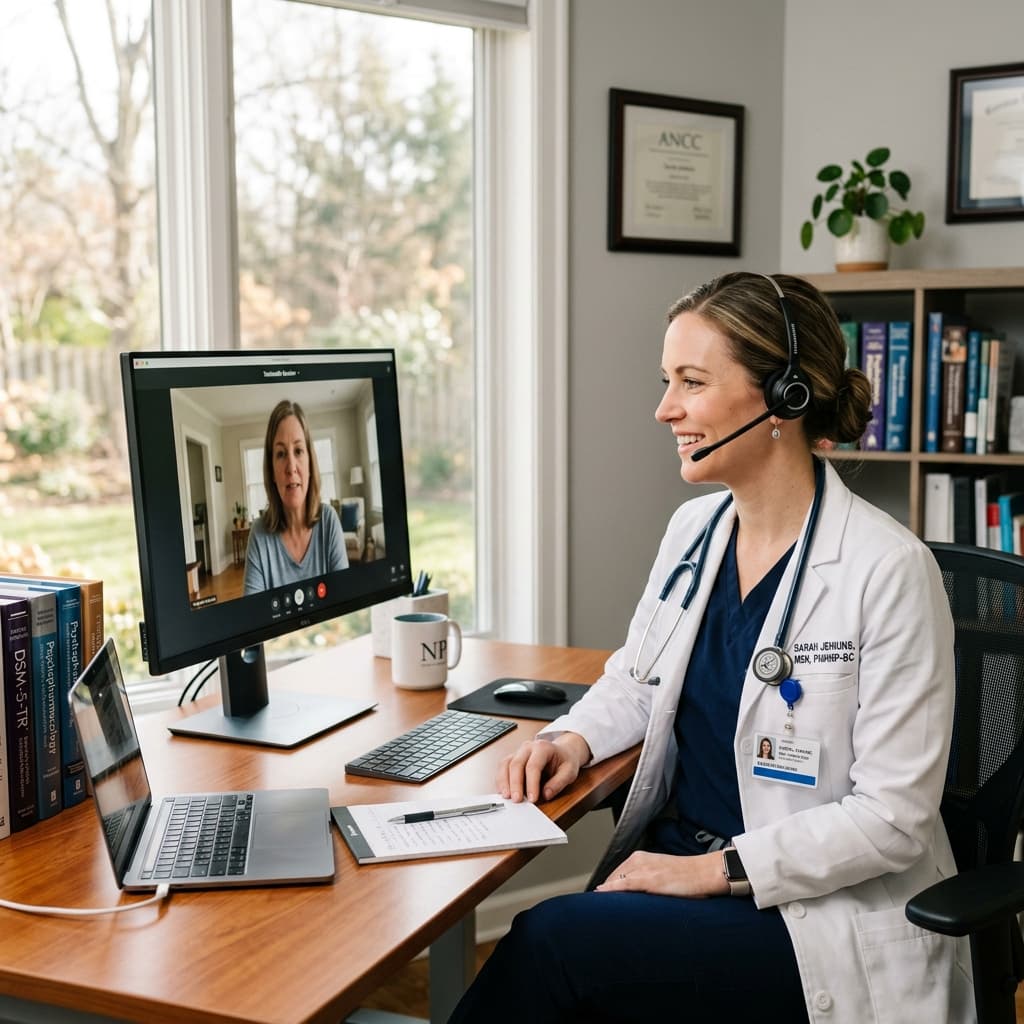
Telehealth PMHNP roles offer flexibility and an average salary of $145,000 - $175,000. Success requires high-speed internet (>100Mbps), HIPAA-compliant workspace, multi-state licensure to maximize patient volume, and the ability to build rapport virtually. 62% of new PMHNP jobs now include (AANP Practice Environment Survey, 2025) a partial or full telehealth component. Expect to see 12-16 patients per day with notes completed within 24 hours.
Working from home in pajamas sounds like the dream. And for many PMHNPs, it genuinely is. But telehealth is a specific clinical skill set, not just a location change. It requires different boundaries, tech infrastructure, virtual rapport-building techniques, and clinical adaptations that your PMHNP program probably didn't cover in depth.
This guide covers the reality of being a "Virtual PMHNP" in 2026 — what the daily workflow actually looks like, what employers measure, and how to distinguish yourself in an increasingly competitive telehealth market.
A Day in the Life of a Telehealth PMHNP
Here's what a typical telehealth day actually looks like — not the marketing version, but the real one:
8:30 AM — Log in from your home office. Review today's schedule (12-16 appointments). Check overnight patient portal messages, lab results, and pharmacy refill requests. Flag anything urgent. 9:00 AM — First patient: 45-minute intake evaluation for a new patient with treatment-resistant depression. History gathering, medication review, safety assessment — all through video. You're simultaneously building rapport and typing notes in the EHR on your second monitor. 9:45 AM — 15-minute follow-up: Stable ADHD patient. Medication check, refill prescription, brief check-in on side effects. Four minutes of documentation after. 10:00 AM — Two more follow-ups back-to-back. 10:30 AM — Patient no-show. This happens 10-15% of the time in telehealth (ATA Telehealth Benchmarks, 2024). Use this buffer to catch up on charts, complete prior authorizations, or return patient portal messages. Note: Productivity-based compensation models typically don't pay for this time. 10:45 AM — Resume appointments. A complex patient with bipolar disorder and substance use needs medication reconciliation after a recent ER visit. This takes the full 30 minutes plus documentation. 12:00 PM — Lunch. In your own kitchen. No break room politics, no mediocre vending machine coffee. The upside is real. 1:00 PM — Afternoon session: 6-8 follow-ups. Mix of anxiety, depression, PTSD, and ADHD. Most are 15-20 minutes. 3:30 PM — Last patient finishes. One patient had a crisis disclosure that required extended time — you spent an extra 15 minutes on safety planning. 4:00 PM — Documentation completion, prior authorization calls, prescription management, care coordination emails to therapists and PCPs. 4:30-5:00 PM — Sign off and close the laptop. Commute time: zero. The Reality: The isolation is real. You go from being surrounded by colleagues to working entirely alone. Successful remote providers are proactive about seeking peer consultation — schedule weekly case conferences, join clinical supervision groups, and attend conferences. Without deliberate effort, your clinical world shrinks.Technical Requirements — Your "Virtual Clinic"
You cannot run a medical practice on spotty WiFi and a laptop on your kitchen table. This is a clinical workspace, and it needs to meet both technical and regulatory standards.
Essential Equipment
| Equipment | Minimum Spec | Why |
|---|---|---|
| Internet | Hardwired Ethernet, 100+ Mbps down / 20+ Mbps up | WiFi drops mid-session are unacceptable. Run an Ethernet cable to your desk. |
| Backup internet | Mobile hotspot (Verizon, T-Mobile) | When your primary goes down (it will), you need a seamless switch |
| Monitors | Dual 24"+ monitors | One for video call, one for EHR. Non-negotiable for efficient documentation |
| Webcam | 1080p external (Logitech C920/C930/Brio) | Built-in laptop cameras are poor quality and bad angles |
| Microphone | USB headset or condenser mic | Clear audio matters more than video quality for patient communication |
| Lighting | Key light or ring light at face level | Prevents the "shadow face" look; projects professionalism |
| Background | Professional, neutral backdrop | Some use virtual backgrounds, but a real bookshelf or plant is better |
| Room | Private, lockable door | HIPAA requires this — non-negotiable |
| Chair | Ergonomic, adjustable | You'll sit 8+ hours daily; invest in your spine |
Total Setup Cost
A professional telehealth workspace costs approximately $500-$1,500 to set up from scratch. Many employers provide a technology stipend ($500-$1,000) or equipment directly. Negotiate this during your offer.
Software Stack
- HIPAA-compliant video: Zoom for Healthcare, Doxy.me (free tier works for many), or employer's proprietary platform (Talkiatry, Cerebral, etc.)
- EHR systems: Be proficient in 2-3 major platforms — Epic, Athenahealth, DrChrono, SimplePractice, eClinicalWorks, NextGen
- E-prescribing: EPCS (Electronic Prescribing of Controlled Substances) — required for telehealth opioid, benzodiazepine, and stimulant prescriptions
- PDMP access: Must have accounts in every state where you see patients — check the PDMP before every controlled substance prescription
Licensing: The Secret to Higher Pay
In telehealth, your license portfolio directly determines your earning power. State licensure is the single most important factor in how valuable you are to a telehealth employer.
The Math
- A PMHNP with 1 state license can see patients in that state only — limited patient pool
- A PMHNP with 5 state licenses can see patients across 5 states — moderate value
- A PMHNP with 10+ state licenses is a premium hire — maximum flexibility for the employer
Employers like Talkiatry, Cerebral, and Lifestance actively pay more — or offer sign-on bonuses — for PMHNPs who hold 5+ state licenses because each license opens an entire state's worth of patients.
Best States to Hold Licenses In
| Priority Tier | States | Reason |
|---|---|---|
| Tier 1 (Largest patient pools) | California, New York, Texas, Florida | Highest populations = most patients needing care |
| Tier 2 (High demand + FPA) | Washington, Arizona, Oregon, Colorado | Full Practice Authority + growing populations |
| Tier 3 (Strategic) | New Jersey, Pennsylvania, Ohio, Georgia, Virginia | Large populations with significant psychiatric need |
| NLC / Compact | 40+ states (RN compact) | APRN compact is expanding — stay informed |
Licensing Strategy Tips
- Start applications early: Most states take 4-12 weeks to process; some (California, New York) take longer
- Ask employers to reimburse licensing costs — most national telehealth companies will pay for licenses in states they need
- Track renewal dates carefully — a lapsed license means you cannot see patients in that state, which costs you money
- Budget $200-$800 per state for initial application fees, plus ongoing renewal costs
For detailed state-by-state licensing requirements, see our 50-state licensing guides.
Productivity Expectations — What Employers Measure
Remote employers are data-driven. Unlike in-person clinics where your presence is visible, telehealth success is measured entirely by metrics:
Key Performance Metrics
| Metric | Expected Range | Notes |
|---|---|---|
| Show rate | 85-90%+ | Employers expect you to maintain a no-show rate under 15%. Higher no-show rates signal weak engagement or poor scheduling practices. |
| Daily encounters | 12-16 patients/day | Mix of intakes (45-60 min) and follow-ups (15-20 min). Some employers push for 18-20; be cautious of burnout. |
| Documentation turnaround | Same-day or within 24 hours | Notes must be closed promptly. Many employers audit this. |
| Patient satisfaction | 4.5+ / 5.0 | Survey scores matter; telehealth platforms often tie bonuses to satisfaction metrics |
| Retention rate | 85%+ | How many patients return for follow-up vs. leaving the platform |
Productivity Tips for Telehealth
- Use SmartPhrases/templates extensively — build reusable note components for common conditions (ADHD follow-up, depression f/u, anxiety f/u)
- Type during the appointment — most patients expect this and don't mind seeing you look at a second screen
- Batch similar appointments — schedule all ADHD follow-ups in one block, all intakes in another
- Build in buffer — schedule 5-minute breaks every 2 hours. Back-to-back video calls for 8 hours is a recipe for "Zoom fatigue"
- Reduce no-shows — send appointment reminders, offer easy rescheduling, and call patients who miss appointments
Clinical Adaptations for Virtual Practice
Telehealth psychiatry requires specific clinical adjustments that differ from in-person practice:
Building Rapport Through a Screen
- Look at the camera (not the screen) when the patient is talking — this creates the feeling of eye contact
- Slow down your pace — video introduces micro-delays that can feel jarring if you talk at normal speed
- Use verbal acknowledgments more frequently ("I hear you," "that makes sense") because patients can't read your body language as easily
- Check in explicitly — "How is this format working for you? Can you hear me clearly?"
- Name the awkwardness — "Video visits feel different from in-person. It's normal to find this a bit strange at first."
Safety Assessment Adaptations
- Verify the patient's physical location at the start of every session (required for crisis purposes)
- Have local emergency contacts for every patient — if a patient becomes acutely suicidal, you need their local 911 and crisis team information readily accessible
- Develop a "telehealth safety plan" protocol — who do you call if a patient becomes unresponsive or makes active threat?
- Document firearm access and safety precautions in a dedicated field
Prescribing Considerations
- Ryan Haight Act compliance — controlled substance prescribing via telehealth has permanent DEA flexibilities post-COVID, but state-specific rules vary. Stay current with your state board's telehealth prescribing regulations.
- Check PDMP in the patient's state (not your state) before every controlled substance prescription
- Coordinate with local pharmacies — patients in rural areas may have limited pharmacy options
Compensation Models in Telehealth
W-2 Telehealth Positions
| Experience | Salary Range | Benefits |
|---|---|---|
| New grad | $125K-$145K | Full benefits + mentorship (some companies) |
| 3-5 years | $150K-$175K | Full benefits + productivity bonuses |
| 5+ years | $165K-$190K | Benefits + possible leadership roles |
1099 Contract Telehealth
| Appointment Type | Rate Range |
|---|---|
| Follow-up (15-20 min) | $75-$100 per visit |
| Intake (45-60 min) | $125-$200 per visit |
| After-hours/weekend | +20-30% premium |
See the 1099 vs W-2 comparison for detailed analysis of which model is better for your situation.
Is Telehealth Right for You?
YES, If:
- You are self-disciplined, organized, and don't need external structure to stay productive
- You are tech-savvy and can troubleshoot basic connectivity and software issues
- You crave work-life balance and want to eliminate commute time
- You have a quiet, private, lockable space for patient encounters
- You are proactive about seeking peer support and continuing education on your own
MAYBE NOT, If:
- You are a brand-new graduate who needs hands-on clinical mentorship — virtual supervision is harder to get and less immersive
- You get significant energy from being physically around colleagues
- You have a home environment with children, pets, or noise that cannot be reliably contained during work hours
- You struggle with work-life boundaries when work and home occupy the same space
The Bottom Line
Telehealth is a legitimate, permanent, and growing mode of psychiatric practice. It's not a fallback or a pandemic compromise — it's a career choice that offers extraordinary flexibility, competitive compensation, and the ability to serve patients who might otherwise go without care. But it requires intentional setup, clinical adaptation, and proactive boundary-setting to do well.
Ready to go remote? Browse Telehealth PMHNP Jobs | Remote Jobs | Companies hiringSources Data in this article is sourced from:
- Bureau of Labor Statistics (BLS), Occupational Outlook Handbook, May 2024 — bls.gov/ooh
- American Association of Nurse Practitioners (AANP), NP Fact Sheet, 2025 — aanp.org
- PMHNP Hiring aggregated job board data (May 2026)
- Telehealth Companies Hiring PMHNPs — Platform-by-platform comparison
- Ultimate Guide to Remote PMHNP Jobs — Broader remote career guide
- 1099 vs W-2 for NPs — Compensation model comparison
- PMHNP Salary Guide 2026 — Full compensation data
- Multi-State DEA Guide for Telehealth PMHNPs — Licensing strategy for multi-state practice
- PMHNP 1099 Tax Guide — Tax strategies for independent contractor PMHNPs