
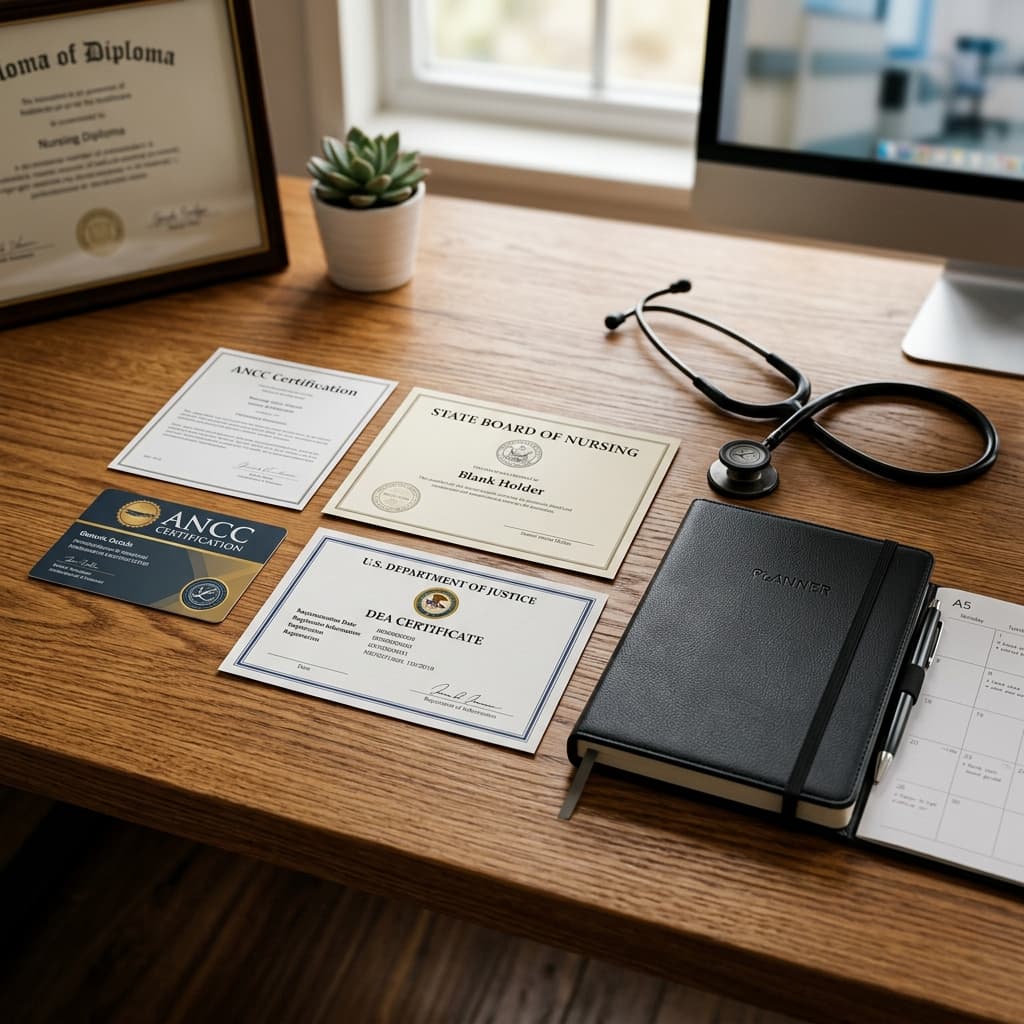
PMHNP credentialing requires: ANCC PMHNP-BC certification ($395 exam), state APRN license ($150-$500, 2-16 week processing), DEA registration ($888/3 years), NPI number (free, instant), and CAQH ProView profile (free). Insurance panel credentialing takes 90-180 days per payer. Plan to spend $2,000-$3,500 total on initial credentialing and 3-6 months from graduation to first patient.
Credentialing is the bridge between graduating from your PMHNP program and actually seeing patients. While it can feel like an overwhelming maze of forms, applications, and waiting periods, understanding the process — and doing things in the right order — will save you months of unnecessary delays and thousands of dollars in lost income.
Every week you spend waiting for credentials is a week you're not earning a PMHNP salary. Getting this right from the start matters.
The PMHNP Credentialing Roadmap
Here's the complete sequence, in the order you should tackle it:
Step 1: ANCC PMHNP-BC Certification
- What: National board certification from the American Nurses Credentialing Center
- Cost: $395 (ANCC member) or $500 (non-member)
- Format: 175 multiple-choice questions, 3.5 hours, computer-based testing at Prometric centers
- Pass rate: ~85% for first-time test-takers
- Renewal: Every 5 years (75 CE hours + 1,000 practice hours)
- Timeline: Schedule exam → typically test within 2-4 weeks → results within 48 hours
Step 2: State APRN License
- What: Advanced Practice Registered Nurse license in your practice state
- Cost: $150-$500 (varies significantly by state)
- Requirements: Active RN license, PMHNP-BC certification (or pending), graduate transcripts, background check, fingerprinting (most states)
- Processing time: 2-16 weeks (varies widely)
| Processing Speed | States | Average Timeline |
|---|---|---|
| Fast (2-4 weeks) | TX, FL, AZ, CO, UT, NV, GA, WA | Best for quick starts |
| Moderate (4-8 weeks) | OH, PA, IL, VA, NC, MN, OR, MD | Standard timeline |
| Slow (8-16 weeks) | CA, NY, NJ, MA, CT, MI | Plan ahead — apply early |
- California: BRN processes APRN applications slowly (8-16 weeks). Apply the day you graduate.
- New York: Requires a separate controlled substance registration (CSR) on top of DEA
- Texas: Requires a separate prescriptive authority application filed through the BON
- Florida: Requires a supervisory protocol filed with the Board before prescribing
For complete requirements in each state, see our 50-state licensing guides.
Step 3: DEA Registration
- What: Drug Enforcement Administration registration for prescribing controlled substances (Schedules II-V)
- Cost: $888 for 3 years ($296/year effective)
- Timeline: 4-6 weeks online processing
- Note: Required in EVERY state where you prescribe controlled substances — a separate DEA is needed for each state
- Apply at: deadiversion.usdoj.gov
- MATE Act requirement: 8 hours of substance use disorder training required at initial or renewal registration
Step 4: NPI Number
- What: National Provider Identifier — your permanent, unique provider ID number for billing
- Cost: Free
- Types: Type 1 (individual — you need this) and Type 2 (organizational — needed for group/private practice billing)
- Timeline: Instant (online application)
- Apply at: nppes.cms.hhs.gov
- Note: Your NPI never changes or expires — get it once, keep it forever
Step 5: CAQH ProView Profile
- What: Universal credentialing database used by 90%+ of insurance companies and most employers
- Cost: Free for providers
- Timeline: 2-4 hours to complete initially; re-attest quarterly
- Why it matters: Required for virtually all insurance panel applications and most employer credentialing
- Apply at: proview.caqh.org
Step 6: Insurance Panel Credentialing
- What: Applying to be an in-network provider with insurance companies
- Cost: Free to apply (no application fees)
- Timeline: 90-180 days per payer — this is the longest step
- Major panels to apply for:
- Medicaid (state-specific application)
- Blue Cross Blue Shield (largest commercial insurer)
- UnitedHealthcare / Optum (especially for behavioral health)
- Aetna
- Cigna
- Humana
- Magellan / Carelon Behavioral Health
Pro tip: Start ALL panel applications simultaneously — don't wait for one to complete before starting the next. The 90-180 day timeline runs in parallel across all payers. For employed positions: Most employers handle insurance credentialing for you. Ask during the interview how long their credentialing process takes — some health systems process in 30-45 days using their own credentialing departments.Multi-State Licensing Strategies
For telehealth PMHNPs who need licenses in multiple states, a strategic approach saves time and money:
Priority Order for Multi-State Licensing
- Your home state — Always first
- States with the most patients — CA, TX, FL, NY, PA (largest populations)
- Fast-processing states — TX, FL, AZ, CO (get quick wins while slow states process)
- Full Practice Authority states — No collaborative physician needed — see FPA guide
- NLC compact states — Nurse Licensure Compact simplifies the RN component; APRN compact is expanding
Cost Planning for Multi-State Practice
| # of States | Initial Licensing Cost | DEA Cost (per 3 years) | Annual Renewal Costs | Total Year 1 |
|---|---|---|---|---|
| 1 state | $150-$500 | $888 | $100-$300 | $1,138-$1,688 |
| 5 states | $750-$2,500 | $4,440 | $500-$1,500 | $5,690-$8,440 |
| 10 states | $1,500-$5,000 | $8,880 | $1,000-$3,000 | $11,380-$16,880 |
Tracking Your Credentials
With multiple licenses, DEA registrations, and renewal dates, organization is critical:
- Create a spreadsheet tracking every credential: license number, state, expiration date, renewal requirements, CE hours needed
- Set calendar reminders 90 days before every expiration — license lapses mean you cannot see patients
- Keep digital copies of everything in a secure cloud folder — you'll need credentials repeatedly for employer applications, insurance panels, and privilege requests
- Consider a credentialing service like Credsy or Modio if you have 5+ state licenses ($50-$150/month)
Timeline: From Graduation to First Patient
| Week | Milestone | Action Items |
|---|---|---|
| 0 (Graduation) | Program complete | Apply: state APRN license (pending certification), NPI number, CAQH profile |
| 1-2 | Certification exam | Take ANCC PMHNP-BC exam, receive results |
| 2-4 | Certification confirmed | Update state application with certification; apply for DEA |
| 4-8 | State license issued | Receive APRN license; update CAQH with license number |
| 6-10 | DEA registration | Receive DEA; begin insurance panel applications |
| 10-24 | Insurance credentialing | Panel applications processing (90-180 days) |
| 8-12 | Begin seeing patients | Start with employer-credentialed positions while panels process |
Common Credentialing Mistakes
- ❌ Waiting to apply until after certification — Apply for state license and NPI during your last semester
- ❌ Starting insurance credentialing late — Begin panel applications 6 months before you want to see patients privately
- ❌ Letting CAQH lapse — Re-attest quarterly or insurers will drop you from panels without notice
- ❌ Not reading state-specific requirements — Some states require additional forms, specific fingerprinting vendors, or separate controlled substance registrations
- ❌ Missing renewal deadlines — A lapsed license = inability to see patients = lost income. Set calendar reminders 90 days out.
- ❌ Not keeping organized records — Scan everything digitally; you'll need credentials dozens of times throughout your career
- ❌ Assuming DEA covers all states — You need a separate DEA registration for EACH state where you prescribe controlled substances
- ❌ Forgetting the MATE Act training — 8 hours of SUD training is now required for DEA registration/renewal
The Bottom Line
Credentialing is a 3-6 month process that requires patience, organization, and parallel processing. Start early, apply to everything simultaneously, keep meticulous records, and don't let any single step become a bottleneck. The investment ($2,000-$3,500) and effort are modest compared to the career they unlock.
Ready to start practicing? Browse PMHNP jobs or check practice authority in your state.The Cost of Getting Credentialed
Many new PMHNPs are surprised by the upfront costs of starting practice. Here is a realistic budget for initial credentialing in a single state:
| Item | Cost | Frequency |
|---|---|---|
| ANCC PMHNP-BC certification exam | $395 | One-time (renewal every 5 years, $375) |
| State APRN license | $100-$500 | Annual or biennial renewal |
| DEA registration | $888 | Every 3 years |
| NPI number | Free | One-time |
| CAQH ProView setup | Free | Re-attest every 120 days |
| Malpractice insurance | $1,200-$3,500/year | Annual |
| Total initial cost | $2,583-$5,283 |
Understanding Prescriptive Authority
One of the most important aspects of PMHNP licensure is prescriptive authority — the legal right to prescribe medications, including controlled substances. Requirements vary significantly by state:
Full prescriptive authority states: PMHNPs can prescribe all medication classes, including Schedule II-V controlled substances, without physician involvement. This is the standard in FPA states. Limited prescriptive authority states: Some states restrict PMHNP prescribing of certain drug classes (e.g., Schedule II stimulants or benzodiazepines) or require a physician co-signature for controlled substance prescriptions. DEA registration: All PMHNPs who prescribe controlled substances must obtain a federal DEA registration ($888 for 3 years). In states where you practice telehealth across state lines, you may need a DEA registration in each state where patients are located — a significant cost for multi-state telehealth providers. State-specific requirements: Some states require additional training (e.g., opioid prescribing education) before granting controlled substance prescriptive authority. Check your state board of nursing requirements before assuming your PMHNP certification grants full prescribing rights.Common Credentialing Mistakes to Avoid
The credentialing process can delay your start date by weeks or months if handled incorrectly. Here are the most common mistakes new PMHNPs make and how to avoid them:
1. Starting credentialing too late. Insurance panel credentialing takes 60-120 days on average. Start the process immediately upon accepting a position — do not wait for your start date. 2. Incomplete CAQH profile. CAQH ProView is the universal credentialing database used by most insurance companies. Keep your profile 100% complete and re-attest every 120 days. An incomplete CAQH profile is the number one reason for credentialing delays. 3. Mismatched information across databases. Your name, NPI, DEA, license number, and practice address must match exactly across CAQH, NPPES, PECOS, state licensing boards, and employer records. Even a middle initial discrepancy can cause rejections. 4. Forgetting Medicare enrollment. If you will see any Medicare patients (including Medicare Advantage), you must enroll as a rendering provider in PECOS (Provider Enrollment, Chain, and Ownership System). This is a separate process from commercial insurance credentialing and takes an additional 30-45 days. 5. Not tracking renewal dates. Create a calendar with every renewal deadline — DEA (every 3 years), state APRN license (varies by state), ANCC PMHNP-BC (every 5 years), CAQH re-attestation (every 120 days), and malpractice insurance (annually). Missing any of these can create gaps in your practice authorization.Multi-State Licensing for Telehealth PMHNPs
If you plan to practice telehealth across state lines, you will need licenses in every state where your patients are located. The Nurse Licensure Compact (NLC) covers RN licenses but does NOT cover advanced practice nursing licenses in most states. This means you must apply individually for APRN licensure in each state.
Cost estimate for 5-state licensure: $1,500-$3,000 (application fees + background checks + state-specific requirements). Most telehealth employers will reimburse these costs, but negotiate this before accepting the position. See our Multi-State DEA Guide for detailed state-by-state requirements.Credentialing Timeline Template
| Week | Action | Estimated Completion |
|---|---|---|
| Week 1 | Complete CAQH ProView profile, apply for NPI if not obtained | NPI: 10-15 business days |
| Week 2 | Submit DEA application, begin state APRN license application | DEA: 4-6 weeks |
| Week 3 | Begin insurance panel applications (start with top 5 payers) | 60-120 days per payer |
| Week 4 | Complete Medicare PECOS enrollment | 30-45 days |
| Week 6 | Follow up on all pending applications, correct any discrepancies | Ongoing |
| Week 8-12 | Most commercial panels should begin approving | Track in spreadsheet |
Related resources:
- Full Practice Authority Guide — State-by-state practice laws
- How to Become a PMHNP — Complete career pathway
- New Grad PMHNP Guide — Landing your first role
- 50-State Licensing Guides — Individual state requirements
Sources Data in this article is sourced from:
- Bureau of Labor Statistics (BLS), Occupational Outlook Handbook, May 2024 — bls.gov/ooh
- American Association of Nurse Practitioners (AANP), NP Fact Sheet, 2025 — aanp.org
- PMHNP Hiring aggregated job board data (May 2026)