
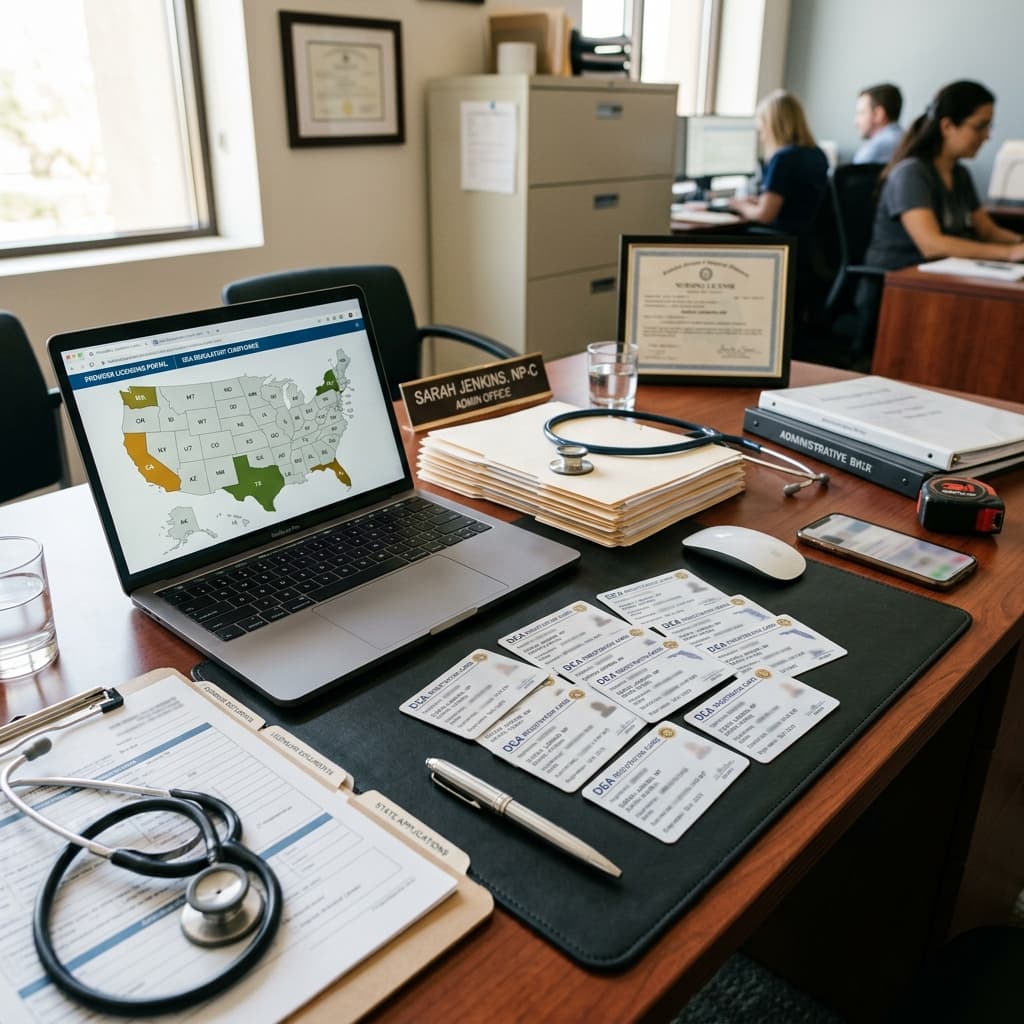
Telehealth PMHNPs prescribing controlled substances need a separate DEA registration for each state where their patients are located — at $888 per state for 3 years ($296/year). With the MATE Act, all DEA applicants must complete 8 hours of SUD training. For a PMHNP licensed in 10 states, multi-state DEA costs approximately $8,880 every 3 years. Many telehealth employers reimburse DEA costs — always negotiate this.
If you're a telehealth PMHNP, your DEA registration is one of your most important — and most expensive — credentials. Unlike your NPI (which is national and free), DEA registrations are state-specific, costly, and require individual applications for each state where you prescribe controlled substances.
Understanding the rules, managing the paperwork, and containing the costs are essential skills for any multi-state psychiatric NP.
The Core Rule: One DEA Per State
The DEA requires a separate registration for each state in which you:
- Write prescriptions for Schedule II-V controlled substances
- Dispense controlled substances
- Conduct research with controlled substances
For telehealth PMHNPs, this means: if your patient is in Texas and you're prescribing Adderall, you need a Texas DEA — even if you're physically sitting in Arizona on your laptop.
What Counts as "Prescribing in a State"?
The determining factor is where the patient is located at the time of the visit, not where you (the provider) are physically located:
| Scenario | DEA Needed In |
|---|---|
| You're in AZ, patient is in TX | Texas DEA required |
| You're in AZ, patient is in AZ | Arizona DEA required |
| You're in AZ, patient is in CA, TX, and FL | CA, TX, AND FL DEA registrations required |
| Patient crosses state line to see you in-person | Your state's DEA only |
DEA Registration: Step-by-Step
New Registration
- Verify prerequisites: Active APRN license in the target state + prescriptive authority
- Complete MATE Act training (if not already done — one-time 8-hour requirement)
- Apply online at deadiversion.usdoj.gov
- Pay fee: $888 for 3-year registration
- Processing time: 4-6 weeks for online applications
- Receive registration: DEA number will be mailed and available online
MATE Act Training Requirement
The Medication Access and Training Expansion (MATE) Act requires:
- 8 hours of substance use disorder (SUD) training
- Required for all new DEA registrations and renewals (starting January 2023)
- Topics covered: Opioid/SUD identification, evidence-based treatments (MAT), counseling techniques, overdose prevention
- Accepted training providers: SAMHSA/PCSS (free), ASAM, AAFP, AMA — see our MAT Guide for recommended courses
- You only need to complete this once — not per state. Your training certificate covers all DEA registrations.
Cost Management Strategies
Multi-state DEA registrations add up fast. Here's how to minimize the financial impact:
DEA Cost Projections
| # of States | 3-Year Cost | Annual Cost | Monthly Cost |
|---|---|---|---|
| 1 | $888 | $296 | $25 |
| 3 | $2,664 | $888 | $74 |
| 5 | $4,440 | $1,480 | $123 |
| 10 | $8,880 | $2,960 | $247 |
| 15 | $13,320 | $4,440 | $370 |
Strategies to Reduce DEA Costs
- Negotiate employer reimbursement: Most national telehealth companies (Talkiatry, Cerebral, Iris Telehealth) will reimburse DEA fees for states they need. This should be a standard negotiation point in every telehealth contract.
- Prioritize strategically: You don't need a DEA in every state you're licensed in — only states where you prescribe controlled substances. If you can manage some patient populations without scheduled medications (therapy-only, non-controlled prescribing), you may not need a DEA in every licensed state.
- Align renewal dates: Try to submit all DEA applications around the same time period so renewals cluster together — easier for tracking and budgeting.
- Tax-deduct everything: All DEA fees, MATE training costs, and state licensing fees are 100% tax-deductible business expenses on Schedule C (or as an employee unreimbursed expense). See our 1099 Tax Guide.
- Consider state-specific alternatives: Some states (e.g., New York) have their own controlled substance registration (CSR) in addition to federal DEA. Factor these into your cost calculations.
PDMP Registration: The Other Requirement
In addition to DEA registration, most states require PDMP (Prescription Drug Monitoring Program) registration:
| State PDMP Requirement | States |
|---|---|
| Mandatory registration + check before prescribing | Most states (40+) — must check PDMP before prescribing controlled substances |
| Registration required, checking encouraged | A few states with voluntary checking |
| No PDMP requirement | Missouri (until recently the only state without a PDMP — now has one) |
PDMP Best Practices for Multi-State Providers
- Register proactively: Apply for PDMP access in each state as soon as you receive your DEA — the registration process can take 1-4 weeks
- Use PMP InterConnect: Many states participate in the PMP InterConnect system, allowing you to check patient histories across state lines from a single login
- Check before every controlled substance prescription — even if not mandated; it's best clinical practice and protects your license
- Document PDMP checks in your clinical notes for every controlled substance prescribing decision
Scheduling and Prescriptive Authority Variations
Not all states grant PMHNPs the same prescribing authority for controlled substances:
| Authority Level | States (Examples) | What You Can Prescribe |
|---|---|---|
| Full Schedule II-V | AZ, CO, WA, OR, NM, NV, MT, ID, WY (FPA states) | All controlled substances independently |
| Schedule II-V with collaboration | TX, FL, GA, NC, VA, OH | All schedules, but need physician collaboration agreement |
| Schedule III-V only | AL, OK (and a few others) | Cannot prescribe Schedule II (stimulants, some opioids) independently |
| Additional state registration | NY (CSR), some others | Need state-specific controlled substance registration on top of DEA |
See our Full Practice Authority Guide and 50-state licensing guides for complete state-by-state requirements.
Tracking and Organization
Managing 5-15 DEA registrations, plus APRN licenses, plus PDMP accounts, plus renewal dates is a significant administrative burden. Here's a system:
Recommended Tracking Template
| State | APRN License # | Expiration | DEA # | DEA Expiration | PDMP Registered? | CSR (if applicable) | Notes |
|---|---|---|---|---|---|---|---|
| AZ | APRN-12345 | 12/2027 | FA1234567 | 03/2028 | ✅ | N/A | Home state |
| TX | APRN-67890 | 06/2027 | FT2345678 | 09/2027 | ✅ | N/A | Restricted — need collab |
| NY | APRN-11111 | 09/2028 | FN3456789 | 12/2028 | ✅ | CSR-22222 | Need NYS CSR too |
Organization Tools
- Spreadsheet (Google Sheets/Excel) — Simple, effective, shareable with credentialing teams
- Credsy or Modio ($50-$150/month) — Credentialing management platforms with automated renewal reminders
- Calendar alerts — Set 90-day-before-expiration reminders for every credential
- Cloud storage — Keep scanned copies of every registration, certificate, and receipt in a dedicated folder
Frequently Asked Questions
Can I prescribe controlled substances across state lines without a DEA in the patient's state?
No. Federal law requires a DEA registration in the state where controlled substances are prescribed. Prescribing without proper registration is a federal offense.
Do I need a DEA if I only prescribe non-controlled medications?
No. If your telehealth practice doesn't involve any Schedule II-V medications, you don't need a DEA in that state. However, most psychiatric practices prescribe at least some controlled substances (stimulants, benzodiazepines, gabapentin in some states).
Can my employer's DEA cover me?
No. DEA registrations are individual, not institutional. Your employer's DEA covers their practice; you need your own personal DEA registration.
What happens if my DEA lapses?
You cannot prescribe any controlled substances in that state until the registration is renewed. This could disrupt patient care and violate your employment agreement. Set renewal reminders well in advance.
The Bottom Line
Multi-state DEA management is the most expensive and administratively complex aspect of telehealth PMHNP practice. Budget $2,000-$10,000+ annually depending on your state portfolio, negotiate employer reimbursement aggressively, and maintain meticulous tracking to avoid lapses. The administrative burden is real, but the career flexibility and earning potential of multi-state practice more than justify the investment.
Ready to expand your practice? Browse remote PMHNP jobs and telehealth positions, or see our Licensing & Credentialing Guide for the full credentialing roadmap.Related resources:
- Licensing & Credentialing Guide — Complete credentialing process
- Full Practice Authority Guide — State-by-state practice laws
- Remote PMHNP Jobs Guide — Landing remote positions
- Addiction & MAT Guide — MATE Act training details
- 1099 Tax Guide — Tax-deducting DEA and licensing costs
Sources Data in this article is sourced from:
- Bureau of Labor Statistics (BLS), Occupational Outlook Handbook, May 2024 — bls.gov/ooh
- American Association of Nurse Practitioners (AANP), NP Fact Sheet, 2025 — aanp.org
- PMHNP Hiring aggregated job board data (May 2026)