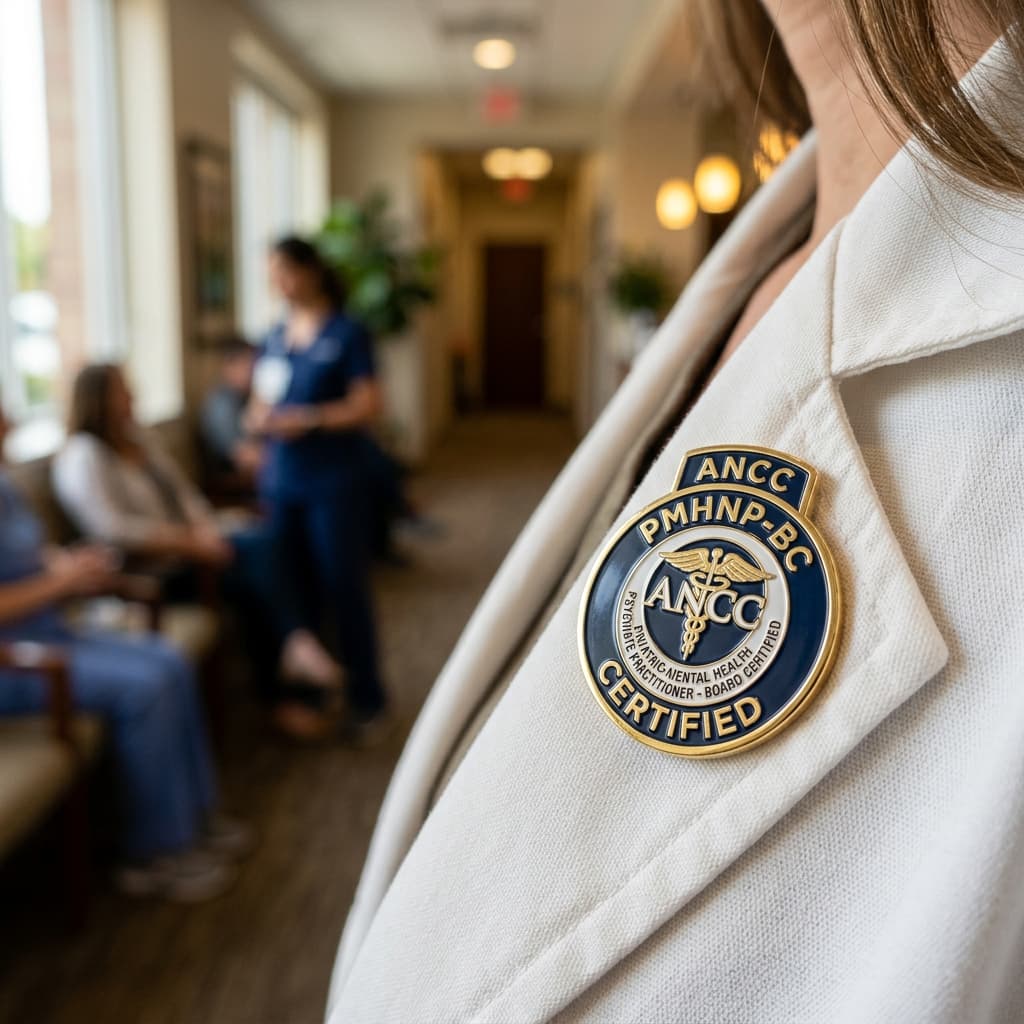
PMHNP-BC stands for Psychiatric Mental Health Nurse Practitioner, Board Certified. It means the provider has completed a graduate nursing program with a psych/mental health specialization and passed the national certification exam administered by the American Nurses Credentialing Center (ANCC). It is the most widely held certification for psychiatric nurse practitioners in the United States.
If you've seen "PMHNP-BC" after a provider's name and wondered what it means, or you're a nursing student deciding whether to pursue this credential, this guide breaks down everything you need to know.
What Each Letter Stands For
| Letter(s) | Meaning |
|---|---|
| P | Psychiatric |
| MH | Mental Health |
| NP | Nurse Practitioner |
| BC | Board Certified |
The full expanded title is: Psychiatric Mental Health Nurse Practitioner, Board Certified.
You may also see it written as PMHNP-BC on a provider's white coat, business card, or clinic listing. It is a nationally recognized credential, not a degree and not a license: your APRN license is issued separately by your state board of nursing.
How Is PMHNP-BC Different From Other Credentials?
| Credential | What It Means | Key Difference |
|---|---|---|
| PMHNP-BC | Psych Mental Health NP, Board Certified | Can diagnose and prescribe for mental health across the lifespan |
| FNP-BC | Family Nurse Practitioner, Board Certified | Primary care focus, not psychiatric specialty |
| APRN | Advanced Practice Registered Nurse | Umbrella term for NPs, CNMs, CRNAs, and clinical nurse specialists (CNSs) |
| NP | Nurse Practitioner | General term; doesn't specify specialty |
| RN | Registered Nurse | Nurse without prescriptive authority |
| Psychiatrist (MD/DO) | Doctor of Medicine / Doctor of Osteopathic Medicine | Physician: completed medical school + residency |
What Can a PMHNP-BC Do?
A board-certified PMHNP can:
- Diagnose mental health conditions using DSM-5-TR criteria
- Prescribe psychiatric medications (including controlled substances like stimulants and benzodiazepines)
- Provide psychotherapy (CBT, motivational interviewing, supportive therapy)
- Order and interpret lab work, genetic testing, and psychological assessments
- Manage complex medication regimens (polypharmacy, drug interactions)
- Practice independently in Full Practice Authority (FPA) states without physician oversight
The scope of practice varies by state. In FPA states like Washington, Oregon, and Arizona, PMHNPs can open their own private practice. In states like Texas, a collaborative agreement with a physician is required. California lets NPs practice independently only after they qualify as a "104 NP", which takes a 4,600 hour transition to practice and three years in good standing as a "103 NP". Check any state on our practice authority map.
How Do You Earn the PMHNP-BC Credential?
The path to board certification follows these steps:
- Earn a BSN (Bachelor of Science in Nursing): 4 years
- Work as an RN (Registered Nurse): optional for ANCC eligibility, so check whether your graduate program requires RN experience for admission
- Complete a graduate program (MSN or DNP) with PMHNP specialization: 2-4 years
- Accumulate 500+ clinical hours in psychiatric settings
- Pass the ANCC PMHNP-BC certification exam
- Apply for state APRN licensure
For a detailed walkthrough of each step, read our How to Become a PMHNP guide.
The ANCC PMHNP-BC Exam
The certification exam is administered by the American Nurses Credentialing Center (ANCC), which is a subsidiary of the American Nurses Association (ANA).
Exam Details
The ANCC sets the fee and publishes current pass rates, and it revises both periodically. Check the ANCC before you register.
| Detail | Info |
|---|---|
| Questions | 175 (150 scored + 25 pretest) |
| Duration | 3.5 hours |
| Format | Computer-based, multiple choice |
| Cost | $395 non-member; $295 ANA member; $220 APNA member; other discounts on the ANCC certification page |
| Pass rate | High among first-time takers; the ANCC publishes the current figure |
| Renewal | Every 5 years (75 CE contact hours, 25 of them in pharmacology) |
Content Areas
The ANCC test content outline (effective April 28, 2023), linked from the ANCC certification page, divides the 150 scored questions into five domains (percentages rounded by the ANCC):
- Scientific Foundation (33 questions, 22%): advanced pathophysiology, pharmacology and psychopharmacology, neuroscience
- Advanced Practice Skills (41 questions, 27%): clinical interviewing, screening tools, mental status exam, risk assessment, psychiatric emergencies
- Diagnosis and Treatment (33 questions, 22%): DSM-5-TR diagnosis, test selection, medication management
- Psychotherapy and Related Theories (17 questions, 11%): psychotherapy principles such as CBT, change and family theories, therapeutic alliance
- Ethics, Legal Principles, and Cultural Care (26 questions, 17%): informed consent, confidentiality and duty to warn, cultural competence, patient advocacy
Why Do Employers Require PMHNP-BC?
When a job posting says "PMHNP-BC required," it is asking for national board certification as a psychiatric mental health nurse practitioner. Strictly, PMHNP-BC is the ANCC's credential. The AANP Certification Board has offered its own psychiatric mental health NP certification exam since April 2024, so if you hold that certification instead, ask the employer whether it qualifies.
Employers check certification early because credentialing and insurance enrollment often depend on it: without verified board certification, a practice may not be able to bill for your visits. That is why it is rarely negotiable, even in postings that are flexible on schedule, setting, or years of experience.
What the credential does not show is how you practice. It says nothing about the age groups you have treated, the therapy approaches you use, your substance use disorder experience, or the acuity you are comfortable with. Your resume, interview, and references carry that.
Before you apply:
- Make the credential easy to find. Put "PMHNP-BC" in your resume headline and credentials line, and keep license and certification details identical across your resume, LinkedIn, and application portals. Mismatches can slow credentialing later.
- Be upfront if certification is pending. If you are still waiting on the exam or your state license, say so and ask whether the employer will consider you contingent on completion.
Does PMHNP-BC Affect Salary?
Yes, significantly. Board certification is required for most PMHNP positions, so it is the gate to the entire pay range rather than a bonus on top of it. Within that range, three things move the number:- Experience. The gap between a first offer out of school and what a clinician with several years behind them commands is substantial.
- Setting. Inpatient, telehealth, correctional, and private practice all pay differently for the same credential.
- State. Reimbursement rates and practice authority vary enormously, and both feed straight into pay.
For a national anchor, the Bureau of Labor Statistics puts nurse practitioners at a median of $132,300 (BLS Occupational Outlook Handbook, Nurse Practitioners, May 2025). That figure covers all NP specialties, not PMHNPs specifically. For what employers are advertising right now, see the salary guide.
Medicare requires national certification for nurse practitioners who enroll to bill it (42 CFR 410.75). Some states, including California and New York, can certify graduates of their own approved NP programs without national certification, but in practice board certification is the minimum requirement.
See our full 2026 PMHNP Salary Guide for detailed breakdowns by state and setting.
PMHNP-BC Renewal Requirements
Your certification isn't permanent. To maintain your PMHNP-BC credential:
- Renew every 5 years
- Complete 75 continuing education (CE) hours (at least 25 must be pharmacology)
- Maintain an active RN license
- Practice hours are optional: logging 1,000 practice hours in your role is one renewal option in the current ANCC handbook, not a requirement
- Complete at least one more professional development category from the options in the ANCC renewal handbook
Frequently Asked Questions
Q: What does PMHNP-BC stand for?A: Psychiatric Mental Health Nurse Practitioner, Board Certified. It's the national credential from the ANCC.
Q: Is a PMHNP-BC the same as a psychiatrist?A: No. Both diagnose and prescribe, but a psychiatrist has a medical degree (MD/DO) and completed residency. A PMHNP-BC has a nursing degree (MSN/DNP) and board certification. Read our full PMHNP vs Psychiatrist comparison.
Q: Can a PMHNP-BC prescribe controlled substances?A: Yes, within state law. That can include stimulants (Adderall, Vyvanse), benzodiazepines, and buprenorphine for addiction treatment. You need a DEA registration in each state where you practice plus state prescriptive authority, and some states restrict NP prescribing of Schedule II drugs such as stimulants.
Q: How often do you have to renew PMHNP-BC?A: Every 5 years. You need 75 continuing education contact hours (25 of them in pharmacology) plus at least one other professional development category from the ANCC renewal handbook; logging 1,000 practice hours is one option, not a requirement.
Ready to start your PMHNP career?
Browse New Grad PMHNP Jobs and All PMHNP Jobs to see what's available.
Sources
- Bureau of Labor Statistics, Occupational Outlook Handbook, Nurse Practitioners (pay as of May 2025): https://www.bls.gov/ooh/healthcare/nurse-anesthetists-nurse-midwives-and-nurse-practitioners.htm
- American Nurses Credentialing Center, Psychiatric-Mental Health Nurse Practitioner Certification (PMHNP-BC): https://www.nursingworld.org/our-certifications/psychiatric-mental-health-nurse-practitioner/