
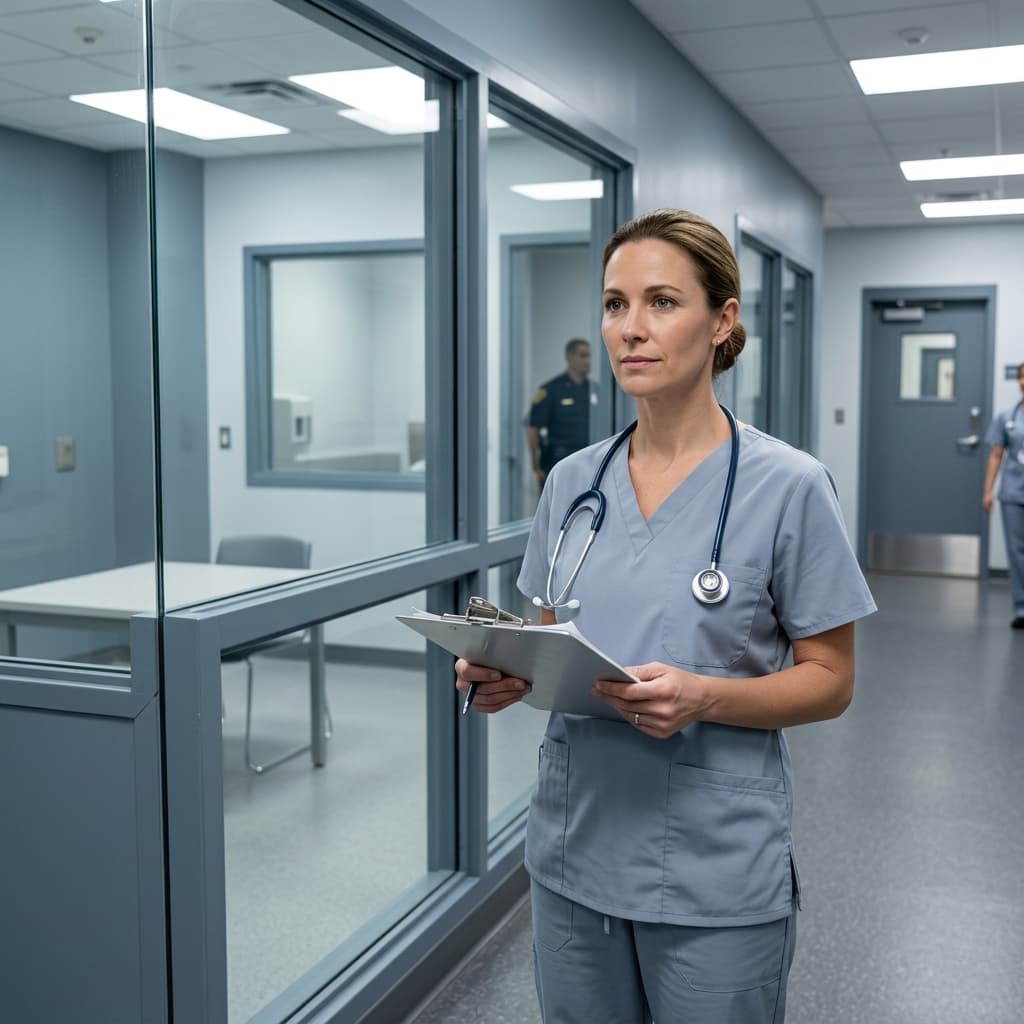
Correctional PMHNPs earn $160,000-$210,000 — a 15-25% premium over community mental health. Benefits include clinical autonomy, loan forgiveness eligibility (NHSC, PSLF, state programs), and predictable schedules (no call in most facilities). The work involves managing serious mental illness, substance withdrawal, crisis intervention, and forensic evaluations in jails, state prisons, and federal facilities.
Correctional and forensic psychiatry is one of the most misunderstood — and most rewarding — PMHNP career paths. Behind the stereotypes lies a niche that offers premium compensation, clinical autonomy rarely found in other settings, and the opportunity to serve a population desperately underserved by the healthcare system.
The Correctional Mental Health Crisis
Consider these numbers:
- 2.2 million Americans are incarcerated — the largest incarcerated population in the world
- 37% of state prisoners and 44% of jail inmates have a diagnosed mental health condition
- 65% of incarcerated individuals meet criteria for a substance use disorder
- There are fewer than 1 psychiatric provider per 500 inmates in most state systems
- Suicide is the leading cause of death in local jails — psychiatric providers directly save lives
The math is clear: there are not enough psychiatric providers in corrections, and the demand will only grow as mental health screening improves, courts mandate treatment, and MAT programs expand across correctional systems.
Salary & Compensation
Correctional PMHNP compensation consistently exceeds community market rates:
| Setting | Salary Range | Benefits | Loan Forgiveness |
|---|---|---|---|
| County/city jails | $145,000-$175,000 | Variable (county benefits) | Varies by county |
| State prison system | $155,000-$195,000 | State employee benefits, pension | Many states offer |
| Federal BOP (Bureau of Prisons) | $150,000-$185,000 | Full federal benefits package | EDRP available |
| Private correctional companies | $165,000-$210,000 | Employer-provided | Rare |
| Forensic hospitals (state) | $155,000-$195,000 | State benefits | Often PSLF-eligible |
| Locum tenens (correctional) | $110-$175/hour | Agency-provided malpractice | N/A |
Why the Premium Pay?
- Difficulty recruiting — The setting deters many providers; the "prison" label scares candidates who haven't experienced it
- Clinical complexity — Dual-diagnosis, polysubstance use, medication interactions, limited formulary, malingering assessment
- Security constraints — Additional operational complexity (locked doors, movement restrictions, escort requirements)
- Retention incentives — Facilities invest heavily in keeping experienced providers who understand the environment
- 24/7 populations — Inmates don't go home. Their psychiatric needs are your facility's responsibility around the clock.
Loan Forgiveness Opportunities
Correctional facilities frequently qualify for multiple student loan repayment programs:
| Program | Amount | Requirements |
|---|---|---|
| NHSC Loan Repayment | Up to $50,000 for 2-year commitment (renewable) | Must work at eligible site |
| PSLF (Public Service Loan Forgiveness) | Total remaining balance after 120 payments | Government or qualifying nonprofit employer |
| Federal EDRP (BOP positions) | Up to $200,000 over 5 years | Bureau of Prisons employment |
| State loan repayment programs | $10,000-$100,000+ | Varies by state; many have corrections-specific programs |
What Correctional PMHNP Practice Looks Like
Daily Schedule (Typical)
| Time | Activity |
|---|---|
| 7:00-7:30 | Arrive, clear security checkpoint, team huddle with nursing staff |
| 7:30-9:00 | Acute intakes — new arrivals needing psychiatric assessment and crisis evaluations |
| 9:00-11:30 | Scheduled follow-up appointments (medication management, chronic care) |
| 11:30-12:30 | Lunch, chart review, respond to urgent sick call requests |
| 12:30-3:00 | Continued scheduled appointments, interdisciplinary team meetings |
| 3:00-3:30 | Segregation/restrictive housing rounds — evaluate inmates in isolation |
| 3:30-4:00 | Documentation completion, team communication, depart |
Common Presentations
- Serious mental illness: Schizophrenia, schizoaffective disorder, bipolar I — often undertreated before incarceration. The correctional system may be a patient's first contact with consistent psychiatric care.
- Substance withdrawal: Alcohol, opioid, benzodiazepine detox protocols. Many facilities now offer MAT with buprenorphine — see our MAT guide.
- Mood disorders: Depression with suicidal ideation (heightened risk in first 72 hours of incarceration), anxiety, adjustment disorders, PTSD.
- Personality disorders: Antisocial PD and borderline PD are highly prevalent; complicates treatment planning and requires strong boundaries.
- Malingering assessment: Determining genuine illness vs. secondary gain (seeking medication, housing assignment, or disability). This is a unique clinical skill developed in corrections.
- Competency evaluations: Fitness-to-stand-trial assessments, capacity evaluations, and involuntary medication recommendations. Forensic-specific work.
- Intellectual disabilities: Higher prevalence than community; requires adapted communication and treatment approaches.
Medication Management Considerations
Prescribing in corrections has unique constraints and opportunities:
- Restricted formulary — Limited medication options compared to community; you learn to be creative within constraints
- Crush and dissolve requirements — Anti-diversion protocols for medications at risk of being hoarded or traded
- No PRN benzodiazepines — In most facilities, BZDs are strictly controlled due to diversion risk. You rely more on hydroxyzine, gabapentin, and behavioral interventions.
- Controlled substance scrutiny — Schedule II prescribing is heavily monitored; stimulants for ADHD are particularly scrutinized
- Long-acting injectables (LAIs) — Increasingly preferred for serious mental illness (Haldol Decanoate, Invega Sustenna, Aristada) — ensures medication compliance
- Medication adherence monitoring — DOT (directly observed therapy) is standard for high-risk medications
- Creative prescribing — Working within formulary constraints develops strong psychopharmacology skills and forces evidence-based decision-making
Security & Safety Considerations
Training You'll Receive
- Facility-specific security orientation (typically 1-2 weeks of paid training)
- Personal safety techniques and verbal/physical de-escalation training
- Emergency response protocols (codes, lockdowns, facility-wide emergencies)
- PREA (Prison Rape Elimination Act) training
- Mental health crisis intervention within a secure environment
- Use of personal protective equipment and body alarms
Day-to-Day Safety
- You are never alone with a patient without security accessible
- Patients are typically escorted to and from appointments by correctional officers
- Personal items are limited (no cell phones, limited personal belongings — security provides lockers)
- Facilities have panic buttons and rapid response teams
- Violence against mental health staff is rare — inmates generally respect and appreciate psychiatric providers because you're one of the few people in the facility there to help them
Common Provider Concerns (Addressed)
"Won't I feel unsafe?"Most PMHNPs report feeling safe after the initial 2-4 week adjustment period. Security is omnipresent, and mental health providers are generally respected by the incarcerated population. You are providing a service they need and often cannot access elsewhere.
"Will it affect me emotionally?"Yes — but positively for many providers. Correctional psychiatry is deeply impactful work. You're treating people at their most vulnerable, often providing their first experience of consistent psychiatric care. That said, vicarious trauma and compassion fatigue are real — self-care, clinical supervision, and peer support are essential.
"Is the clinical work intellectually stimulating?"Absolutely. Complex comorbidities, diagnostic challenges (genuine illness vs. malingering vs. personality pathology), psychopharmacology within formulary constraints, and creative problem-solving make correctional psychiatry one of the most intellectually demanding and stimulating PMHNP practice areas.
Forensic Psychiatry vs Correctional Psychiatry
These terms are often conflated, but they represent distinct (overlapping) career tracks:
| Aspect | Forensic Psychiatry | Correctional Psychiatry |
|---|---|---|
| Primary focus | Legal evaluations, court-ordered assessments, expert testimony | Ongoing clinical treatment of incarcerated patients |
| Setting | Courts, forensic hospitals, private practice, state hospitals | Jails, prisons, detention centers |
| Key clinical skills | Competency evaluations, insanity defense, risk assessment, legal report writing | Medication management, crisis intervention, substance withdrawal, MAT |
| Additional certification | AFN-BC (forensic nursing) helpful; AAPL equivalent | None required beyond PMHNP-BC |
| Income | $170,000-$220,000 | $155,000-$210,000 |
| Patient relationship | Often evaluative (one-time assessments) | Longitudinal treatment relationship |
Getting Started in Correctional Psychiatry
No Special Certification Required
Unlike many specializations, you can start in correctional psychiatry with your standard PMHNP-BC certification. Additional training and credentials that strengthen your candidacy:
- MAT/buprenorphine training — Essential for managing the high prevalence of substance use disorders (see our MAT guide)
- Forensic nursing certificate — Available through IAFN (International Association of Forensic Nurses)
- De-escalation/crisis intervention — CPI (Crisis Prevention Intervention) or similar certification
- CCHP certification — Certified Correctional Health Professional through NCCHC (National Commission on Correctional Health Care)
- Trauma-informed care training — Highly relevant given the prevalence of trauma histories
Top Employers
- State departments of correction — Direct government employment with state benefits and pension
- Federal Bureau of Prisons (BOP) — Federal salary + full benefits package + EDRP loan repayment
- Wexford Health Sources — One of the largest private correctional healthcare companies
- Wellpath (formerly CCS/CMGC) — Major private correctional healthcare provider
- Centurion Health — Growing correctional healthcare company with national presence
- NaphCare — Correctional healthcare staffing and management
- YesCare (formerly Corizon) — Large correctional healthcare provider
- Locum tenens agencies — CompHealth, Barton Associates, and Integrity Locums have dedicated correctional divisions
The Bottom Line
Correctional and forensic PMHNP work offers premium pay, clinical autonomy, predictable schedules, remarkable loan forgiveness opportunities, and deeply meaningful work. If you can see past the setting and focus on the patients — people who are often at their most vulnerable and least served — you'll find some of the most rewarding psychiatric practice in the country.
Browse openings: Correctional PMHNP jobs | Forensic positions | All PMHNP jobsRelated resources:
- Correctional PMHNP jobs — Current openings
- Addiction & MAT Guide — Essential for correctional practice
- PMHNP Salary Guide 2026 — Compare correctional vs other settings
- Full Practice Authority Guide — State practice laws
Sources Data in this article is sourced from:
- Bureau of Labor Statistics (BLS), Occupational Outlook Handbook, May 2024 — bls.gov/ooh
- American Association of Nurse Practitioners (AANP), NP Fact Sheet, 2025 — aanp.org
- PMHNP Hiring aggregated job board data (May 2026)