
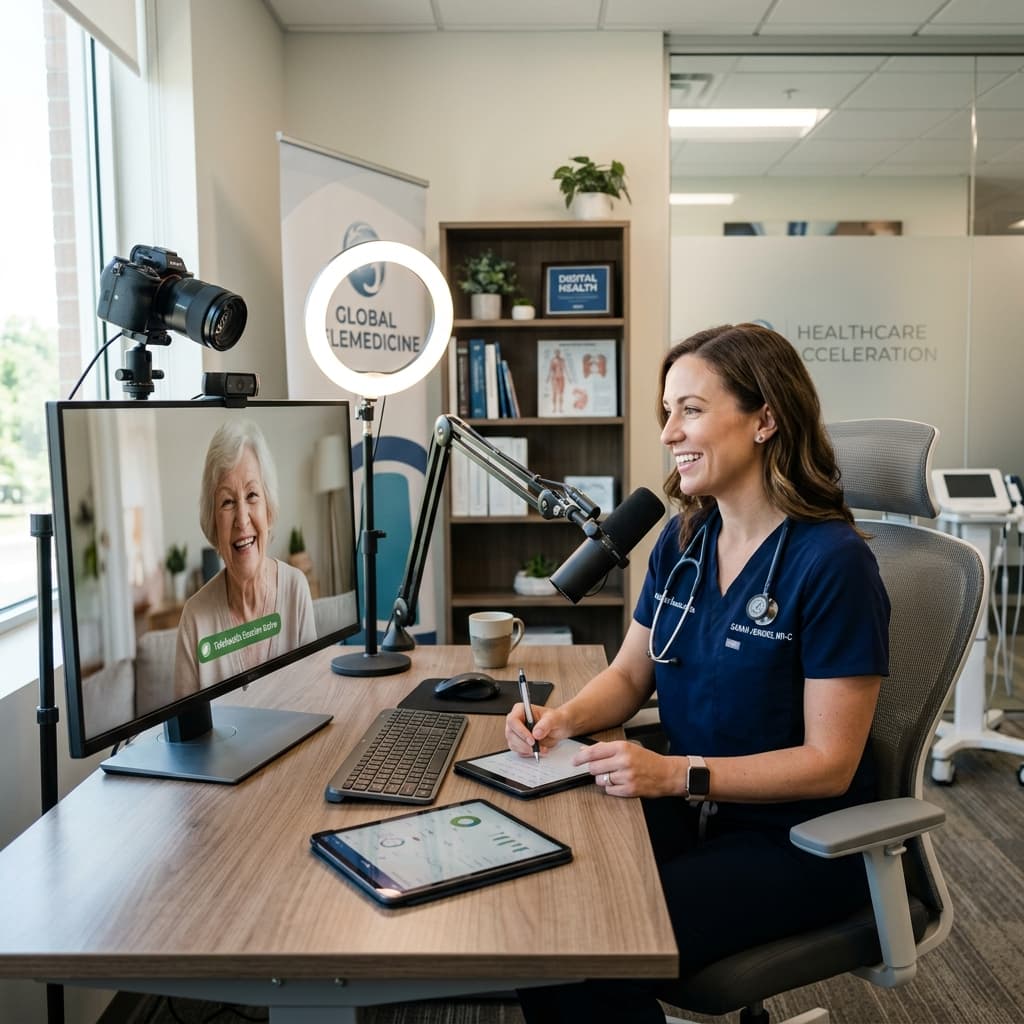
Telehealth PMHNP work has moved from “nice option” to a core hiring channel—and it’s still expanding. If you’re job hunting in 2026, telehealth PMHNP roles are often where the fastest interview cycles, the broadest employer mix, and the most flexible schedules show up.
That doesn’t mean every remote posting is a great job, or that telehealth is easy to break into without the right setup. But if you understand what’s driving demand—and what employers screen for—you can target the roles that actually fit your license, your risk tolerance, and your preferred clinical model.
- Why telehealth PMHNP jobs are the fastest-growing segment
- Telehealth PMHNP pay trends: what’s real, what’s marketing
- Licensing, credentialing, and the multi-state reality of telehealth
- What telehealth employers screen for (and how to stand out)
- A practical job-search plan for telehealth PMHNP roles in 2026
Why telehealth PMHNP jobs are the fastest-growing segment
The growth isn’t a mystery. Patient demand for access is high, and telehealth removes two of the biggest bottlenecks in outpatient psychiatry: travel time and local provider scarcity. Employers also like telehealth because it expands their recruiting radius and helps them fill panels faster. Across our aggregated listings, remote-eligible roles make up about 62% of postings, and average time-to-fill runs around 32 days—two signals that telehealth is no longer a side channel.
Another factor is employer diversification. Telehealth PMHNP hiring isn’t just venture-backed platforms anymore. You’ll see hospital-affiliated outpatient groups, community mental health programs, and traditional private practices adding hybrid or fully remote slots to stabilize access and reduce no-shows.
If you want a quick pulse on what’s live right now, start with the dedicated telehealth PMHNP jobs feed, then compare it with broader remote PMHNP jobs. “Remote” and “telehealth” overlap, but they’re not identical—some “remote” roles are admin-heavy or require periodic onsite days.
Telehealth PMHNP pay trends: what’s real, what’s marketing
Compensation in telehealth can be strong, but it varies more than many candidates expect. Nationally, PMHNP pay commonly lands in the $139K–$155K range, with entry level around ~$126K. Telehealth often pays more than in-person, but the spread depends on how the job is structured.
W-2 telehealth roles tend to be steadier and easier to compare: base salary, benefits, paid admin time, and clearer productivity expectations. 1099 telehealth roles can look higher on paper, but you’re trading stability for variability. If you’re paid per visit, per RVU, or per “billable hour,” your real hourly rate hinges on no-show rates, documentation time, and how quickly you’re assigned a panel.
Watch for the difference between “flexible schedule” and “you’re responsible for filling your own schedule.” Those are not the same job.
If you want a baseline before negotiating, the PMHNP salary guide is a good starting point. Use it to sanity-check offers, then ask employers how they calculate productivity, what percentage of visits are therapy add-ons versus med management, and whether charting time is built into expectations.
Licensing, credentialing, and the multi-state reality of telehealth
Telehealth expands your geographic reach, but it also expands your compliance homework. In most cases, you must be licensed where the patient is located. That means a “remote” job can still be effectively single-state if the employer only serves one state, or it can become multi-state if they operate across several.
Credentialing timelines matter, too. Some telehealth employers can onboard quickly if they have established payer contracts and a streamlined credentialing team. Others will move slowly, especially if they’re adding new states or payers. When you interview, ask what their average credentialing timeline is and whether they can start you with cash-pay visits while insurance credentialing is pending.
A practical way to avoid mismatches is to start your search by location and license. If you’re licensed in a high-volume state, you’ll often see more telehealth options posted daily. For example, you can scan PMHNP jobs in California to see how many roles are remote, hybrid, or in-person—and what employers are consistently hiring.
What telehealth employers screen for (and how to stand out)
Telehealth hiring managers are typically screening for three things: clinical judgment, reliability in a low-supervision environment, and communication skills that translate through video.
Clinical judgment shows up in how you discuss risk, boundaries, and follow-up. Expect questions about safety planning, higher-acuity triage, controlled substance policies, and how you handle uncertain diagnoses without leaning on frequent in-person reassessments.
Reliability is partly operational. Employers want to know you can keep a schedule, document cleanly, and manage asynchronous tasks (refills, portal messages, prior auths) without the wheels coming off. If you’ve worked in high-volume outpatient settings, collaborative care, or any role with heavy inbox management, say so plainly.
Communication is the telehealth “bedside manner.” Clear pacing, structured visits, and patient-friendly education matter more on video. If you have a repeatable visit flow—intake structure, med change framework, follow-up cadence—describe it.
If you’re earlier in your career, telehealth can still be viable, but you’ll want to be selective. Some employers have solid onboarding and clinician support; others are sink-or-swim. It’s worth checking the new grad PMHNP jobs feed to see which organizations are openly building training pipelines versus quietly expecting experienced telehealth clinicians.
A practical job-search plan for telehealth PMHNP roles in 2026
Start by choosing your “non-negotiables” and applying them consistently. Decide whether you want W-2 or 1099, what your minimum support level is (collaboration, supervision, consult availability), and whether you’re willing to add licenses over time. Then filter your search accordingly, instead of applying broadly and hoping the details work out.
Next, treat telehealth postings like you would a contract: ask about panel assignment speed, no-show mitigation, documentation expectations, and how escalations work when a patient needs a higher level of care. Telehealth can be a great long-term fit, but only when the clinical operations are mature.
Finally, automate your search. Telehealth roles move quickly, and the best ones don’t stay open long. Set up PMHNP job alerts so you’re seeing new postings as they go live, not a week later.
Telehealth PMHNP is growing fast, but “remote” isn’t a benefit by itself—it’s a delivery model. When you evaluate the support structure behind the screen, you’ll spot the roles that pay fairly, protect your license, and let you practice good psychiatry.
Browse telehealth PMHNP jobs: https://pmhnphiring.com/jobs/telehealth
Sources Data in this article is sourced from:
- Bureau of Labor Statistics (BLS), Occupational Outlook Handbook, May 2024 — bls.gov/ooh
- American Association of Nurse Practitioners (AANP), NP Fact Sheet, 2025 — aanp.org
- PMHNP Hiring aggregated job board data (May 2026)