
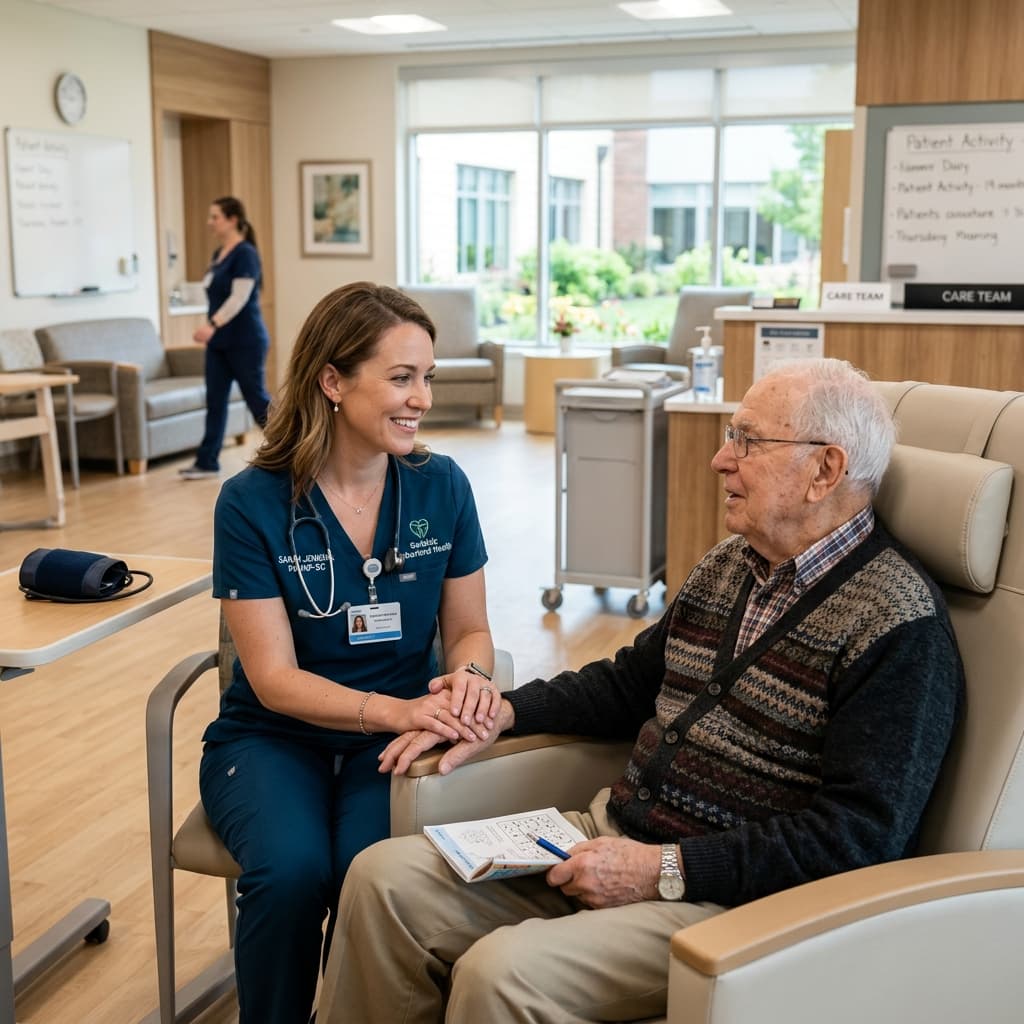
Geropsychiatric NPs specialize in diagnosing and treating mental health conditions in older adults (65+), including dementia-related behavioral symptoms, late-life depression, anxiety, psychosis, and delirium. With 10,000+ baby boomers turning 65 daily and a severe geriatric psychiatrist shortage, demand for geropsychiatric PMHNPs is surging — especially in nursing homes, VA systems, and telehealth. Geropsych NPs earn a salary premium of $10K-$30K over general PMHNPs, particularly in SNF consulting roles.
The intersection of aging populations and mental health represents one of the fastest-growing and most recession-proof niches in psychiatric nursing. By 2030, every single baby boomer will be over 65, creating an unprecedented demand for providers who understand the unique psychiatric needs of older adults — a demand that the existing workforce cannot meet.
Why Geropsychiatry Is Booming
The Numbers Tell the Story
- 10,000 Americans turn 65 every day — this demographic wave will continue through 2030 and beyond
- 20% of adults 65+ have a diagnosable mental health condition, and that number rises to 50%+ in residential care
- Only ~1,600 geriatric psychiatrists practice in the US — for a population of 56+ million Americans over 65
- 90% of nursing home residents have at least one mental health condition requiring treatment
- Dementia diagnoses are projected to reach 13 million by 2050, up from 6.7 million today
- Late-life depression affects 15-20% of older adults but is accurately diagnosed and treated in fewer than half of cases
- Suicide rates for adults 85+ are among the highest of any age group — yet screening in this population is rare
The Provider Gap Is Severe
The geriatric psychiatrist workforce is shrinking, not growing. Most practicing geriatric psychiatrists are themselves over 60, and few residency spots focus on geriatric specialization. This creates one of the most dramatic supply-demand mismatches in all of healthcare:
There are fewer than 1,700 board-certified geriatric psychiatrists in the entire country — approximately one for every 33,000 older adults with a mental health condition. PMHNPs are filling this gap, particularly in settings where psychiatrists have historically been scarce:
- Nursing homes and skilled nursing facilities (SNFs) — where 90%+ residents need mental health care but fewer than 20% of facilities have a psychiatric provider
- VA geropsych units — the aging veteran population (average age now 65+) drives increasing demand
- Memory care and assisted living communities — growing fastest among residential care types
- Home-based geriatric psychiatry programs — serving homebound elderly who cannot travel to appointments
- Consultation-liaison (C-L) services in hospitals — older adults represent 40%+ of hospital admissions and frequently develop delirium, depression, or behavioral crises during hospitalization
- Telehealth geropsychiatry — exploded post-COVID and continues growing, especially for rural elderly
What Geropsychiatric PMHNPs Do
Common Conditions Treated
| Condition | Prevalence in 65+ | PMHNP Role |
|---|---|---|
| Depression | 15-20% (up to 40% in SNFs) | First-line medication management (avoiding TCAs, selecting geriatric-safe SSRIs/SNRIs), therapy referral, ECT collaboration |
| Anxiety disorders | 10-15% | Medication adjustment with emphasis on benzodiazepine avoidance/tapering, CBT adaptations for older adults |
| Dementia behavioral symptoms (BPSD) | 80% of dementia patients | Non-pharmacological interventions first, judicious antipsychotic use, caregiver education, DICE approach |
| Delirium | 30% of hospitalized elderly | Diagnosis (distinguishing from dementia), medication review, workup coordination, prevention protocols |
| Late-life psychosis | 3-5% | Antipsychotic management with Beers Criteria awareness, close metabolic monitoring, fall risk assessment |
| Substance misuse | Growing rapidly | Alcohol use disorder (most common), benzodiazepine dependence, opioid misuse, prescription medication misuse |
| Grief and bereavement | Very common | Complicated grief assessment, differentiation from major depression, supportive care, group therapy referral |
| Insomnia | 40-50% | CBT-I (first-line), medication management avoiding benzodiazepines and anticholinergics, sleep hygiene education |
| Apathy/Withdrawal | 30-40% in dementia | Differentiation from depression, behavioral activation strategies, caregiver coaching |
Unique Clinical Skills Required
Geropsychiatry demands specialized knowledge that standard PMHNP programs cover only briefly. The clinical decision-making framework is fundamentally different from adult psychiatry because of the intersection of aging physiology, polypharmacy, and cognitive decline:
Psychopharmacology in Aging:- Altered pharmacokinetics: decreased renal clearance (GFR declines ~1% per year after 40), reduced hepatic metabolism (CYP enzyme slowing), increased body fat (extended half-lives for lipophilic drugs), decreased serum albumin (higher free drug levels)
- Beers Criteria mastery — the American Geriatrics Society's evidence-based list of medications that are potentially inappropriate for older adults. You must know which psychiatric medications are on this list and why (e.g., benzodiazepines, anticholinergic antidepressants, certain antipsychotics)
- "Start low, go slow, but don't go too low" — the geriatric dosing principle that balances cautious titration with reaching therapeutic doses
- Polypharmacy management: the average 65+ patient takes 5+ medications. Every psychiatric medication you prescribe may interact with statins, antihypertensives, diabetes drugs, anticoagulants, and pain medications
- Fall risk analysis: psychiatric medications (especially sedating ones) are a leading cause of falls in the elderly — and falls are the #1 cause of injury-related death in older adults
- Distinguishing Alzheimer's disease, vascular dementia, Lewy body dementia, frontotemporal dementia, and mixed dementias — each requires different treatment approaches
- Lewy body dementia is particularly critical: antipsychotic sensitivity can cause severe neuroleptic malignant syndrome or rapid functional decline
- Pseudodementia (depression-related cognitive impairment) vs true neurodegenerative disease — the treatment implications are profound
- Understanding cognitive screening tools: MoCA, MMSE, clock draw, mini-cog, and their clinical limitations
- Assessing decision-making capacity for medical decisions, financial decisions, living situation changes, and legal matters
- This is a PMHNP-level skill that is in high demand — especially in SNFs and hospitals
- MacArthur Competence Assessment Tool (MacCAT) and informal bedside capacity assessments
- Understanding the difference between capacity (clinical) and competency (legal)
- Educating and supporting family caregivers is a significant component — caregiver burnout rate exceeds 40%
- Behavioral management coaching for dementia caregivers: redirection, environmental modifications, validation therapy
- Navigating family dynamics around care decisions, placement, and end-of-life psychiatric care
Certification & Training Pathways
Formal Pathways
- Post-Graduate Certificate in Geropsychiatry: Several universities offer geriatric-focused PMHNP post-graduate certificates. Notable programs include University of Pennsylvania, Duke University, and Rush University. These typically require 200-400 additional clinical hours in geriatric settings.
- VA Geropsych Fellowship Programs: The VA offers paid postgraduate fellowships specifically in geropsychiatric care. These are structured 12-month programs with a competitive salary ($80K-$100K), mentorship from geriatric psychiatrists, and often a pathway to a permanent VA position afterward. Programs at VA Greater Los Angeles, Durham VA, and others actively recruit PMHNPs.
- ANCC Gerontological NP Certification: While not psych-specific, this credential complements your PMHNP-BC for geriatric-focused roles and signals specialized expertise to employers.
- Continuing Education: The American Association for Geriatric Psychiatry (AAGP) offers specialized CE courses, annual conferences, and networking. The Alzheimer's Association also provides clinical training programs. Many state boards accept geriatric-focused CE for license renewal requirements.
- Dementia Care Specialist Certification: Programs through the National Council of Certified Dementia Practitioners (NCCDP) provide formal dementia care credentials that enhance your geropsych profile.
Building Geropsych Skills on the Job
Even without a formal fellowship, you can systematically build geropsychiatric expertise through:
- Nursing home consulting — Many facilities contract PMHNPs for 1-2 days/week; ask local SNFs if they need psychiatric coverage
- VA rotations or PRN work — VA MHRRTP and geropsych units welcome experienced PMHNPs for PRN shifts
- Dementia specialty conferences — Alzheimer's Association annual conference, AAGP annual meeting, International Psychogeriatric Association
- Beers Criteria mastery — Required knowledge for any geriatric prescriber; study the current (2023) version thoroughly
- Capacity evaluation training — MacArthur Competence Assessment Tool training courses are offered online
- Geriatric pharmacology CE courses — Focus specifically on psychopharmacology in aging; AAGP and University of Iowa offer excellent online modules
- Shadow a geriatric psychiatrist — Even 2-3 clinic days provides enormous insight into geropsych-specific clinical reasoning
Work Settings & What to Expect
Nursing Home / SNF Consulting
This is the most common and often highest-paying geropsychiatric PMHNP role:
- Structure: Visit 1-3 facilities per week, see 10-20 patients per day. Initial evaluations take 30-60 minutes; follow-ups are 15-20 minutes.
- Compensation: $150-$250/hour or $1,200-$2,500/day; annual earnings of $160K-$220K. Many SNF consulting roles are 1099 contracts.
- Autonomy: Very high — you're often the only psychiatric provider in the facility. Staff rely on your guidance for behavioral management.
- Documentation: CMS documentation requirements for SNF psychiatric services are specific — learn the medical necessity criteria for consult visits.
- Challenges: Complex polypharmacy interactions, limited diagnostic resources (no labs on-site at many facilities), staff education needs, family dynamics around dementia care.
- Bonus: Many SNF consulting positions are flexible/part-time — ideal for supplemental income or a portfolio career.
VA Geropsychiatry
- Structure: Outpatient clinic (Community Living Center, geropsych clinic) or inpatient geropsych unit
- Compensation: $120K-$175K + federal benefits package (pension, EDRP up to $200K, FEHB, 5+ weeks PTO)
- Patient population: Aging veterans with PTSD that manifests differently in older adults (often as depression, anxiety, or cognitive decline), late-life depression, substance misuse, dementia including TBI-related cognitive changes, and complicated bereavement
- Advantage: Full Practice Authority regardless of state, robust interdisciplinary teams (geriatric psychiatrists, psychologists, social workers, chaplains), structured mentorship for newer providers
- Special programs: GRECC (Geriatric Research, Education and Clinical Centers), Home-Based Primary Care (HBPC) with psychiatric integration, Telehealth geropsych (CV-TEL)
Telehealth Geropsychiatry
A rapidly growing model, especially post-COVID:
- Structure: Video visits with elderly patients, often with caregiver assistance. Initial visits 45-60 minutes, follow-ups 20-30 minutes.
- Compensation: $130K-$180K remote (W-2); $75-$150/hour for 1099 contract work
- Challenge: Technology barriers for elderly patients require caregiver involvement; hearing difficulties may complicate video visits; falls and physical assessment limitations
- Opportunity: Serves rural elderly populations who cannot travel to specialists; multi-state licensure opens enormous geographic reach; growing number of telehealth-only geropsych companies are emerging
- Key skills: Engaging elderly patients through video requires different techniques — slower pacing, larger text for screen sharing, caregiver coaching through the platform
Hospital-Based Consultation-Liaison (C-L)
- Structure: Respond to psychiatric consult requests across the hospital, primarily for elderly patients with delirium, depression, behavioral crises, or capacity questions
- Compensation: $140K-$190K (W-2, salaried)
- Volume: 5-10 consults per day; emphasis on thorough initial evaluation and clear recommendations
- Advantage: Varied clinical presentations, ongoing relationship with medical teams, high clinical autonomy
- Challenge: Fast-paced, need strong medical knowledge beyond psychiatry, documentation must clearly communicate recommendations to non-psychiatry teams
Salary & Compensation
Geropsychiatric NPs consistently earn a premium over general PMHNP roles due to the specialty knowledge required and the severe provider shortage:
| Setting | Salary Range | Notes |
|---|---|---|
| SNF/Nursing home consulting | $160K-$220K | Often 1099, flexible schedule, per-patient or daily rate |
| VA geropsych | $120K-$175K | + federal benefits worth $50K+ (pension, EDRP, FEHB) |
| Hospital-based C-L | $140K-$190K | Consultation-liaison roles, W-2 with full benefits |
| Private practice (geriatric focus) | $150K-$200K+ | Cash-pay geropsych is growing; adult children often pay |
| Telehealth geropsych | $130K-$180K | Remote, growing demand, multi-state reach |
| Home-based programs | $140K-$175K | Lower volume, higher per-visit complexity and pay |
Career Outlook: A 20-Year Growth Certainty
Geropsychiatry is one of the most recession-proof and growth-certain PMHNP specializations you can choose:
- The aging population is a demographic certainty — not a market trend that could reverse. The 65+ population will grow from 56 million (2020) to 82 million (2050).
- CMS (Medicare) continues expanding mental health coverage for seniors, including recent expansions for telehealth psychiatric services and integration of behavioral health into primary care
- Nursing home regulations increasingly require psychiatric provider involvement — CMS Conditions of Participation mandate psychosocial assessment and treatment
- The geriatric psychiatrist shortage is worsening — most practicing geriatric psychiatrists are themselves 60+ and approaching retirement
- New dementia treatments (anti-amyloid antibodies like lecanemab, donanemab) are increasing the need for providers who can manage the psychiatric comorbidities of patients receiving these novel therapies
- State-level parity laws are expanding Medicare Advantage behavioral health coverage, driving more demand for geriatric psychiatric providers who accept Medicare
The Bottom Line
The provider gap between geropsychiatric demand and supply is enormous, the patient need is urgent, and the specialty rewards clinical depth over volume. Whether you're a new grad considering a specialization or an experienced adult PMHNP looking to expand your scope, geropsychiatry offers guaranteed long-term demand, high autonomy, competitive pay, and deeply meaningful work with a vulnerable population.
Explore geropsychiatric opportunities: Browse all PMHNP jobs | VA PMHNP jobs | VA guide | Salary guideRelated resources:
- Best States for PMHNPs — Where geropsych demand is highest
- PMHNP Salary by State 2026 — Compare compensation across settings
- Licensing & Credentialing Guide — State-specific requirements for geropsych practice
- PRN & Moonlighting Guide — SNF consulting is a top moonlighting opportunity
Frequently Asked Questions
Do I need a separate certification to practice geropsychiatry?
No. Your PMHNP-BC certification covers the full lifespan, including geriatric patients. However, additional credentials like a post-graduate geropsych certificate or the ANCC Gerontological NP certification can make you significantly more competitive for geriatric-focused positions and may command higher compensation.
What's the most common entry point into geropsychiatry?
Nursing home (SNF) consulting is the most accessible entry point. Many facilities are actively looking for PRN or part-time psychiatric NP coverage. You can start with one facility for a few hours per week while maintaining your primary position — this builds experience and determines if geropsych is right for you.
Can new graduates go directly into geropsychiatry?
Yes, especially through VA fellowship programs or supervised nursing home consulting roles. New graduates should seek positions with mentorship from a geriatric psychiatrist or experienced geropsych PMHNP. The VA's geropsych fellowship programs are particularly well-suited for new graduates wanting structured training.
How does geropsychiatric prescribing differ from adult psychiatry?
The fundamental pharmacological principles are different: altered drug metabolism (renal and hepatic decline), increased sensitivity to side effects (especially anticholinergic effects, sedation, orthostatic hypotension), higher fall risk from psychotropic medications, and the Beers Criteria restrictions on certain medication classes. You'll use lower starting doses, slower titration schedules, and more careful polypharmacy management than in general adult practice.
Sources Data in this article is sourced from:
- Bureau of Labor Statistics (BLS), Occupational Outlook Handbook, May 2024 — bls.gov/ooh
- American Association of Nurse Practitioners (AANP), NP Fact Sheet, 2025 — aanp.org
- PMHNP Hiring aggregated job board data (May 2026)