
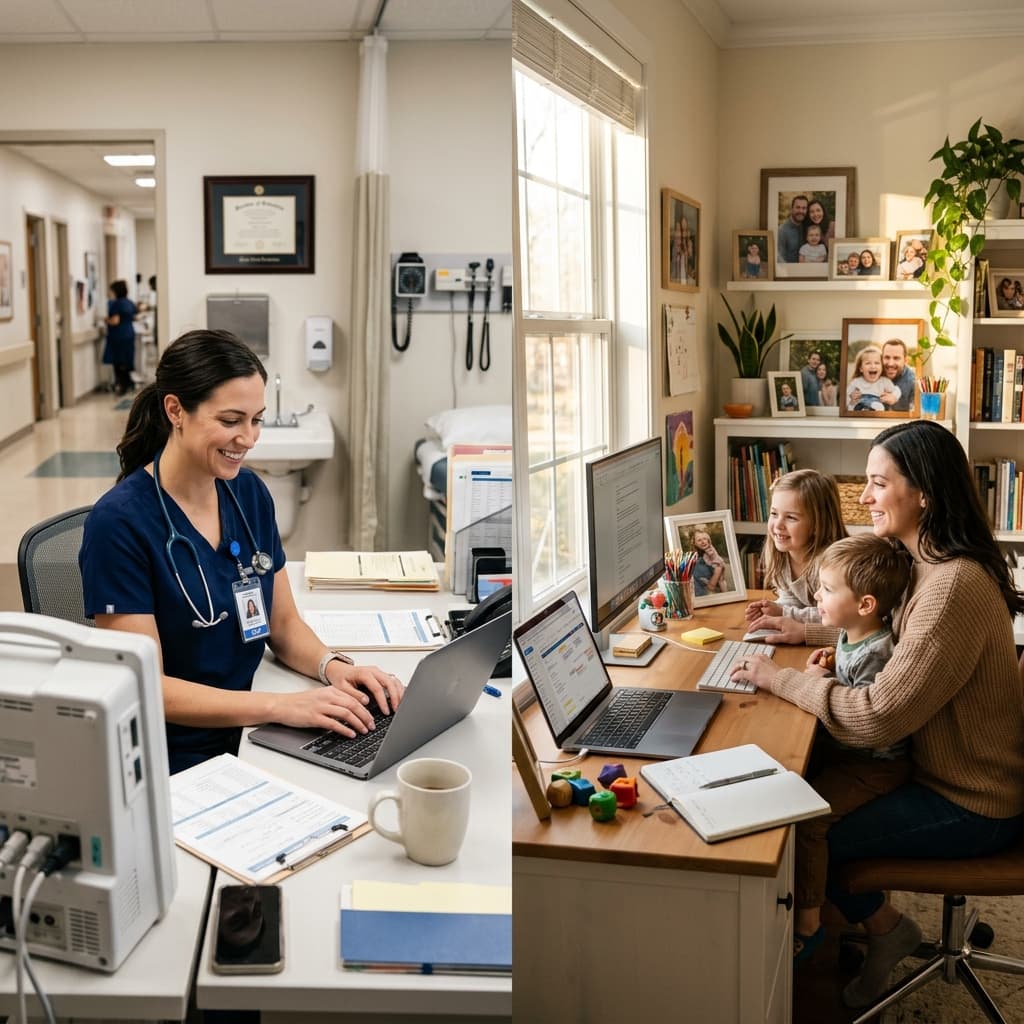
Part-time PMHNP positions pay $60-$120/hour with options including per diem, PRN, weekend-only, half-time, and 1099 contract roles. The best part-time opportunities are in telehealth (easiest schedule flexibility), group practices (half-time with benefits), and per diem hospital shifts (premium hourly rates). Many PMHNPs earn $80,000-$150,000/year working part-time through portfolio career models.
Not every PMHNP wants — or needs — a 40-hour work week. Whether you're supplementing a primary role, easing into retirement, managing family responsibilities, pursuing a second degree, recovering from burnout, or simply prioritizing work-life balance, part-time psychiatric NP work has never been more accessible or better compensated.
The psychiatric NP shortage means most employers are willing to accommodate part-time arrangements rather than risk losing a qualified provider entirely. In 2026, flexibility isn't a perk — it's a recruitment strategy.
Types of Part-Time PMHNP Positions
Per Diem / PRN Shifts
- Hours: As-needed, typically 8-12 hour shifts
- Pay: $65-$120/hour (premium rates compensate for no guaranteed hours)
- Settings: Hospitals, crisis centers, community mental health centers, correctional facilities
- Benefits: Maximum flexibility, highest hourly rates, no long-term commitment
- Drawbacks: No guaranteed hours or employer benefits, unpredictable scheduling, must maintain own malpractice insurance
- Best for: PMHNPs who want supplemental income alongside a primary position, or those who prefer variety
Half-Time W-2 Positions
- Hours: 20-24 hours/week, set schedule (e.g., Monday-Wednesday)
- Pay: $55,000-$85,000/year (pro-rated from full-time equivalent)
- Settings: Group practices, outpatient clinics, VA, community health centers
- Benefits: Often includes pro-rated health insurance, retirement contributions, malpractice coverage, CME allowance
- Drawbacks: Lower total income, may still require minimum patient volume commitments, less schedule flexibility than PRN
- Best for: PMHNPs who want predictability, employer benefits, and consistent schedule
Weekend/Evening-Only Roles
- Hours: 16-24 hours over weekends or evening blocks (Friday-Sunday, or weeknight evenings 5PM-9PM)
- Pay: $70-$110/hour (shift differential premiums of 10-25%)
- Settings: Inpatient psychiatry, crisis stabilization units, emergency departments, residential treatment
- Benefits: Premium pay, weekdays free for family/other obligations/personal pursuits
- Drawbacks: Disruptive to social life, higher-acuity patients, potential for burnout if sustained long-term
- Best for: PMHNPs who want premium pay on concentrated schedules, or those balancing another career/education during weekdays
1099 Contract / Telehealth Side Gig
- Hours: You choose — typically 5-20 hours/week
- Pay: $75-$150/hour
- Settings: Telehealth platforms, private practice overflow, consulting to nursing homes (SNFs)
- Benefits: Total schedule control, work from anywhere, location independence
- Drawbacks: Self-employment tax (15.3%), no employer benefits, administrative burden (billing, taxes, credentialing), must carry own malpractice
- Best for: PMHNPs who prioritize maximum autonomy and are comfortable with self-employment responsibilities
For a detailed comparison of 1099 vs W-2 models, see our 1099 vs W-2 Guide.
Where to Find Part-Time PMHNP Jobs
- PMHNP Hiring job board — Filter by "part-time" or "per diem" job types
- Per diem positions — Dedicated per diem listings
- Telehealth platforms — Many offer part-time panels: Talkiatry, Cerebral, Iris Telehealth, SonderMind, Done
- Locum tenens agencies — Short-term assignments with schedule control. See locum tenens guide
- Local group practices — Call directly; many won't advertise part-time openings online but are happy to accommodate
- VA facilities — Federal part-time positions with pro-rated benefits through USAJobs
- Nursing home networks — SNF psychiatric consulting is inherently part-time and flexible. See geriatric psych guide
- Hospital PRN pools — Contact the APP coordinator at local hospitals to join their on-call roster
Building a Part-Time Portfolio Career
Many PMHNPs create a "portfolio" of part-time roles that collectively provide full-time (or better) income with maximum variety and resilience:
Example Portfolio Configurations
Portfolio A: Balanced (26 hrs/week, $148K/year)- Telehealth platform (1099): 12 patients/week, Tue-Thu mornings → $72,000/year
- Hospital per diem: 2 weekend shifts/month → $28,000/year
- Private practice (own): 6 patients/week, Monday afternoons → $48,000/year
- Total: ~$148,000/year with extraordinary flexibility
- Outpatient group practice (W-2 half-time): 3 days/week → $75,000/year + benefits
- SNF consulting: 1 facility, bi-weekly visits → $18,000/year
- C&P disability exams (remote): 4 exams/month → $27,000/year
- Total: ~$120,000/year with full benefits from primary position
- Telehealth (1099): 16 patients/week → $96,000/year
- Crisis center PRN: 2 shifts/month (12-hr shifts at $175/hr) → $50,400/year
- SNF consulting: 2 facilities → $38,000/year
- Total: ~$185,000/year, no single employer
The portfolio approach provides professional resilience — if one income source disappears, the others continue. It also prevents the stagnation that can come from seeing the same patient population in the same setting for years.
Maintaining Benefits on Part-Time Income
The biggest concern with part-time work is losing employer benefits. Here are practical solutions:
| Benefit | Part-Time Solution | Estimated Annual Cost |
|---|---|---|
| Health insurance | Spouse's plan (free); ACA marketplace ($400-$1,200/month); VA part-time 20+ hrs gets benefits | $0-$14,400/year |
| Retirement | SEP-IRA or Solo 401(k) on 1099 income (contribute up to $66K/year) | Self-funded |
| Malpractice | Individual policy from NSO, CM&F, or Mercer ($1,500-$3,000/year) | $1,500-$3,000/year |
| Disability insurance | Individual long-term disability policy through Northwestern Mutual, Guardian, etc. | $1,200-$3,000/year |
| Life insurance | Individual term policy, separate from employer | $300-$800/year |
| CME/education | Self-funded ($1,000-$3,000/year) — fully tax-deductible on 1099 income | $1,000-$3,000/year |
| PTO | Built into your flexible schedule — you simply choose when not to work | $0 |
Setting Boundaries as a Part-Time Provider
The biggest risk of part-time work isn't financial — it's scope creep. Without clear boundaries, "part-time" quietly becomes 35+ hours as employers lean on you because you're reliable and available.
Protect Your Part-Time Status
- Get it in writing: Schedule, patient volume expectations, and on-call requirements documented in your contract — not verbal agreements
- After-hours coverage: Clarify who handles patient emergencies on your off days. If you're expected to be available for crisis calls on non-working days, that's not truly part-time.
- Declining extra shifts: Practice saying "I'm not available" without guilt. The facility's staffing problem is not your emergency.
- Patient volume caps: If you're hired for 12 patients/week, don't let it creep to 18. When volume pressures come (and they will), refer back to your agreement.
- Documentation time: Ensure clinical hours don't consume all your scheduled time. Budget 10-15 minutes per patient for documentation. If you see 12 patients in a day, that's 3 hours of charting.
- Calendar blocking: Block your off days in your calendar as firmly as you block patient appointments. Protect non-clinical time with the same discipline.
The Bottom Line
Part-time PMHNP work is a legitimate and increasingly popular career model. With hourly rates of $60-$120+, the math often works out better per hour than full-time positions — especially in 1099 or per diem arrangements. The key is intentional design: choose your roles strategically, maintain your benefits independently, and protect your boundaries fiercely.
Browse part-time opportunities: Per diem jobs | Contract positions | All PMHNP jobsTop Part-Time Opportunities for PMHNPs in 2026
The most in-demand part-time roles include:
- Per-diem inpatient rounding in hospitals and skilled nursing facilities ($85-$120/hour)
- Weekend telehealth shifts with platforms like Cerebral, Done, and Talkiatry ($90-$130/hour)
- Veteran disability evaluations for VES, QTC, or LHI ($100-$200 per evaluation, 4-6 per day)
Making Part-Time Work Financially
Many PMHNPs worry that going part-time means a proportional income cut, but the math is more favorable than you think. A PMHNP working 3 days per week at $80/hour W-2 earns approximately $100,000 annually — while gaining 2 additional days for private practice clients at $200-$300 per session. This hybrid model can yield $150,000-$180,000 total while providing the schedule flexibility and clinical variety that prevents burnout. Part-time does not mean part-career — it means strategic career design.
Related resources:
- PRN & Moonlighting Guide — Supplemental income strategies
- 1099 vs W-2 Guide — Compare compensation models
- Remote PMHNP Jobs Guide — Telehealth opportunities
- PMHNP Salary Guide 2026 — Salary data by setting and experience
Frequently Asked Questions
Can new graduates work part-time?
It's possible but not ideal. New grads benefit enormously from full-time mentorship and caseload immersion during their first 12-18 months. After establishing clinical confidence, transitioning to part-time is much smoother. The exception is half-time W-2 positions that include structured supervision.
Will part-time work hurt my long-term career?
No — if you maintain clinical activity and continuing education. Many hiring managers view portfolio careers as evidence of versatility and self-direction. The key is maintaining a minimum patient volume (10-15 patients/week) that keeps your clinical skills sharp.
How do I transition from full-time to part-time?
Start by reducing rather than quitting. Drop to 4 days, then 3. Simultaneously build a secondary income stream (telehealth, consulting) so the financial transition is gradual. Give your employer 60-90 days notice and offer to help recruit your replacement.
Sources Data in this article is sourced from:
- Bureau of Labor Statistics (BLS), Occupational Outlook Handbook, May 2024 — bls.gov/ooh
- American Association of Nurse Practitioners (AANP), NP Fact Sheet, 2025 — aanp.org
- PMHNP Hiring aggregated job board data (May 2026)